
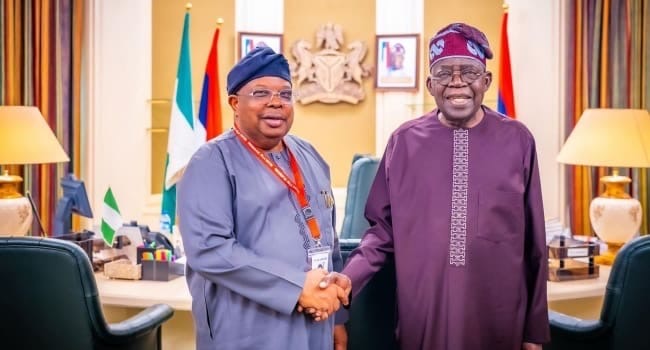
Dear president Tinubu,
The recent improvement in electricity supply across some parts of Nigeria is commendable. Nigerians have noticed it, and we must acknowledge progress whenever it occurs.
However, the problem of supplying electricity to Nigerian households goes far beyond the minimal success we are currently witnessing. The crisis is deeper than power generation and distribution.
The major obstacle remains transmission, which is still controlled and operated by Nigerian civil servants through the Transmission Company of Nigeria.
President Tinubu, there can never be lasting success in the power sector as long as the government continues to leave electricity transmission entirely in the hands of civil servants.
Let me give you a simple example. If you want uninterrupted electricity in your home or neighbourhood, you may only need to have a friend in the transmission office.
In many places, electricity is supplied according to personal relationships, influence and the payment of bribes—not according to the needs of the people or the capacity of the system.
That is the raw truth many Nigerians already know.
Nigerians understand the history of our civil service and the role some public officials have played in the affairs of this country.
Many government ministries, departments and agencies that should be driving national development have been weakened by official corruption, bureaucratic delay, inflated contracts and the diversion of public funds.
Look at what has happened over the years in critical areas such as power, petroleum, aviation, transportation, housing, health, education, agriculture and public works.
Billions and, in some cases, trillions of naira have been budgeted, yet ordinary Nigerians continue to struggle with poor services.
Files disappear, contracts are inflated, projects are abandoned and funds meant for development are sometimes shared by officials and their collaborators.
Privatising electricity generation and distribution while leaving transmission in the hands of civil servants will never produce the desired result.
You cannot privatise the beginning and the end of the electricity value chain while leaving its most important bridge under the same public bureaucracy that contributed to the collapse of the system.
When president Goodluck Jonathan privatised Nigeria’s electricity sector, I wrote to him and warned against leaving transmission in the hands of civil servants.
Partial deregulation has never worked successfully in this country.
It was not until the administration of president Olusegun Obasanjo pulled the rug from under the feet of officials of the defunct NITEL and deregulated the telecommunications industry that Nigerians began to enjoy access to mobile phones and other telecommunications services.
Before that deregulation, obtaining a telephone line in Nigeria was treated like receiving a government appointment. Some people waited for years, while others had to know somebody or pay their way through.
Today, because private investors were allowed to participate fully, nearly every Nigerian can own a telephone line.
That is what genuine deregulation can achieve.
The current deregulation of the petroleum industry is also the reason petroleum products are now flowing more freely into filling stations across Nigeria.
Before now, we all knew that if you did not pay a bribe of about $350,000, you might never receive an allocation to lift even a single cargo from the NNPC. That was how deeply corruption had entered the system.
Nigerians should be thanking their stars for the removal of the petrol subsidy. Without its removal, the whole country might have been in serious trouble by now.
The massive fraud uncovered in previous subsidy-payment arrangements could have become child’s play compared with what Nigeria might have faced if that system had continued unchecked.
President Tinubu, transferring electricity generation and distribution to private investors while leaving the transmission of that same electricity in the hands of civil servants will never solve Nigeria’s epileptic power supply.
Our experience as a nation is very clear. Nigerian civil servants have hardly managed any major commercial public enterprise successfully over the long term.
The Nigerian Railway Corporation, Nigeria Airways, NITEL and several other public institutions were mismanaged, looted and eventually destroyed by some of the same officials who were employed to protect them.
Nigeria Airways once carried our national flag across the world. It disappeared under the weight of corruption and mismanagement.
NITEL, which once controlled telecommunications in Nigeria, collapsed despite the country’s enormous population and demand for telephone services.
The railway system was allowed to decay for decades, even though billions of naira were repeatedly allocated to it.
The same pattern can be seen across many ministries and government agencies.
Money is budgeted every year, but the results are difficult to see. New administrations come with new promises, yet the same civil servants who frustrated previous programmes remain at their desks, controlling files, contracts, approvals and payments.
Some honest civil servants are working hard for Nigeria, and they must be acknowledged. But the system itself encourages delay, secrecy, monopoly and corruption.
No matter how good a government policy may be, officials who benefit from the failure of the system can frustrate it.
President Tinubu, as a matter of urgency, your administration should privatise the Transmission Company of Nigeria and make it mandatory for any serious investor coming into the sector to digitalise the entire transmission network.
Nigeria needs a modern, transparent and technology-driven transmission system.
Electricity allocation and transmission must be monitored digitally so that every megawatt generated can be traced from the generating company through the transmission network to the distribution company and, ultimately, to Nigerian homes and businesses.
The huge allocations made to the Transmission Company of Nigeria are allegedly being looted by some officials working within the system.
Despite the enormous amount of public money committed to transmission, the national grid remains fragile and continues to collapse.
Officials within the transmission system often have little or no regard for the private investors who acquired the distribution companies.
There are also allegations that bribes are demanded before electricity can be transmitted to some distribution companies.
How can the power sector succeed under such a system?
The distribution companies cannot distribute electricity that has not been transmitted to them.
Generating companies may have the capacity to produce more power, but if the transmission network cannot evacuate and deliver it, that power is useless to Nigerian households and industries.
Transmission is the bridge between generation and distribution.
If that bridge remains weak, corrupt and inefficient, the entire electricity industry will continue to fail.
In conclusion, partial privatisation will not solve the epileptic and irrational electricity supply Nigerians are experiencing.
The supply of electricity to Nigerian homes requires total deregulation, transparent regulation and strong encouragement for embedded power generation and private transmission infrastructure.
States, industries, estates, communities and private investors should be allowed and encouraged to generate, transmit and distribute electricity within properly regulated environments.
Nigeria is too large to continue depending on one fragile national transmission network controlled from the centre.
President Tinubu, the recent improvement in electricity supply is a welcome beginning, but it must not be mistaken for the final solution.
If your administration truly wants to transform Nigeria’s power sector, create jobs, revive industries and reduce the cost of doing business, the privatisation and complete digitalisation of the transmission company of Nigeria must become a cardinal point of your power-sector reforms.
Generation has been transferred. Distribution has been transferred. Transmission must no longer remain the sacred territory of corrupt public officials.
The time for total reform is now.
Mogaji Wole Arisekola writes from Ibadan.





Comments