
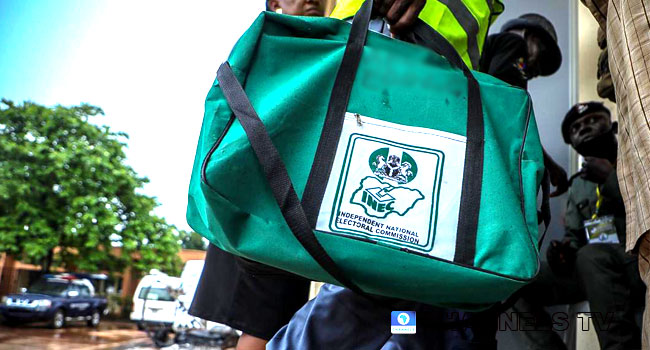
The Independent National Electoral Commission (INEC) has said that it will deploy 707,384 presiding officers for the general elections scheduled to commence on February 25.
The commission also said that since electoral education was important, there was a need to infuse it into the National Values Curriculum (NVC) of primary schools in Nigeria.
The INEC national commissioner and chairman of information and voter education committee, Festus Okoye, made this known during the public presentation of the electoral education curriculum and teachers’ guide for primary schools on Monday evening, January 31.
Okoye said that, “We believe that electoral education is important in the goals of our nation.
“Electoral education is a specialized area and that is why we have this curriculum being infused into the National Values Curriculum in our primary schools.
“For instance, for the 2023 general elections in Nigeria, the commission will deploy a total of 707,384 presiding officers and assistant presiding officers.
“These presiding officers will be drawn from the crop of young men and women doing their National Youth Service Corps (NYSC), while the assistant presiding officers will be drawn from students from federal tertiary institutions.
“It is therefore important for us to understand the importance of electoral education in the development of our democracy.
“A national civic education curriculum and teachers’ guide with a specific focus on electoral education will prepare our children for the challenges ahead and also prepare them on how to respect other people’s races and also prepare them to assume leadership in future,” he added.
The executive secretary of Nigerian Education Research and Development Council (NERDC), Prof. Ismail Junaidu, while speaking on Monday, said that the aim was to strengthen the fabric of the nation’s democracy for sustainable growth and development.
According to him, since the return of democracy in 1999, citizens’ participation in elections and the electoral process had remained an issue of concern, The Punch reports.
He also noted that a known reason for this was the lack of adequate electoral knowledge.
“Hence, promoting democratic electoral culture and developing civic skills are therefore necessary for well-informed and responsible participation in elections and in the electoral process,” Junaidu said.
According to him, the curriculum, generally, is developed to expose young learners to the rudiments of democracy and inculcate in them the knowledge, skills and attitudes necessary for active citizens’ participation in the democratic process.
While commending the management of NERDC for the initiative, the minister of education, Mallam Adamu Adamu, represented by his senior technical assistant, Dr. Claris Ujam, said that the curriculum had become a dynamic process for sustainable national development.
Ujam said that, “Every time, there are changes or developments happening around the world, the school curriculum is affected.
“Therefore, the inclusion of concepts and contents of electoral education under Civic Education is in line with the drive under the ministry’s education for change: A ministerial strategic plan.
“This is to enable the acquisition of citizenship values and skills through quality education.
“The electoral education curricular contents constitute a remarkable step to create positive change in the election landscape and political development,” he added.





Comments