
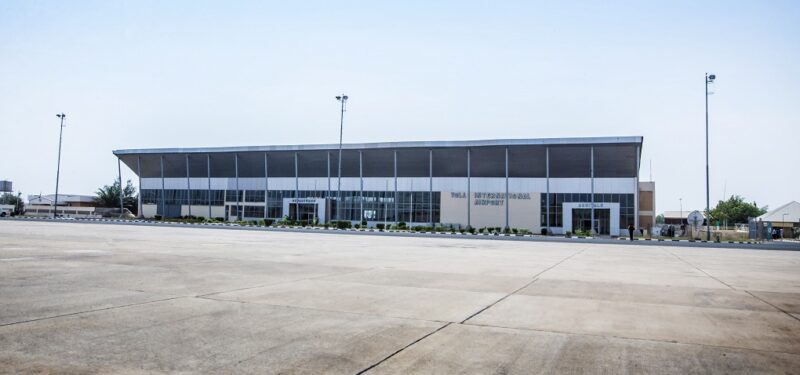
A video footage posted on the social media account of Patience Abbo, wife of former Adamawa North senator, Ishaku Abbo, has exposed a breach of airport security protocols after she gained access to a restricted operational area to escort her husband to the foot of a waiting aircraft.
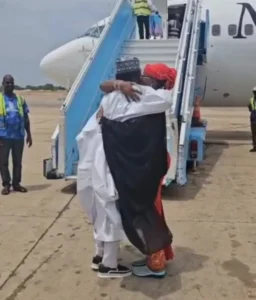
In the video recorded at the Yola Airport, Abbo is seen walking across the apron near the aircraft staircase. She is captured exchanging a black phone case with her husband, embracing him in a farewell gesture, and then turning back as he boarded the plane.
The footage also shows the interaction being recorded from within the restricted area by a third party, raising further questions about who had access to the operational zone at the time.
The video, which remained publicly accessible on her account at the time of filing this report, sparked concerns about the enforcement of Nigeria’s aviation security regulations.
Aviation security globally is governed by strict standards set by the International Civil Aviation Organisation (ICAO). Under ICAO Annex 17, member states are required to establish stringent measures “to prevent unauthorised access to aircraft, restricted airport areas and other sensitive operational zones.”
Nigeria domesticates these standards through the Nigerian Civil Aviation Regulations (Nig.CARs) Part 17 on Aviation Security.
The regulations define the airport airside as “the movement area of an airport, adjacent terrain and buildings or portions thereof, access to which is controlled.”
Under the Nig.CARs Part 17.50 series, aerodrome operators are legally required to implement strict access control measures to prevent unauthorised access to aircraft and to closely supervise all activities around aircraft operations.
Access beyond security screening points to the ramp or aircraft is strictly restricted to screened passengers with valid boarding passes, accredited airline crew, and airport personnel wearing visible On-Duty Cards (ODCs). While regulations make provision for an escort, this is strictly defined as authorised security accompaniment for cleared personnel. It does not extend to casual tarmac farewells by non-travelling family members, only screened travellers and authorised personnel are permitted access to restricted airside areas.
High-profile individuals are not exempt from core safety procedures, everyone is subject to screening.
While certain top-tier VIPs, such as governors, ministers, and first-class traditional rulers, are traditionally afforded protocol aides, regular lawmakers often travel without large entourages. More importantly, no protocol privilege permits a non-travelling spouse to bypass terminal gates onto the aircraft movement area.
Beyond the regulatory breach, security experts warn that the presence of untrained civilians on the airport apron poses serious operational risks.
The video has reignited public debate about the selective enforcement of airport rules in Nigeria. While ordinary citizens are routinely stopped at terminal glass doors and prevented from walking relatives to boarding gates, political elites and their families frequently enjoy unhindered access to aircraft steps through informal “VIP protocol” arrangements.
The incident raises serious questions for FAAN about how a non-travelling civilian and an accompanying videographer gained access to the restricted tarmac, and whether airport security personnel on duty compromised established safety protocols.






Comments