
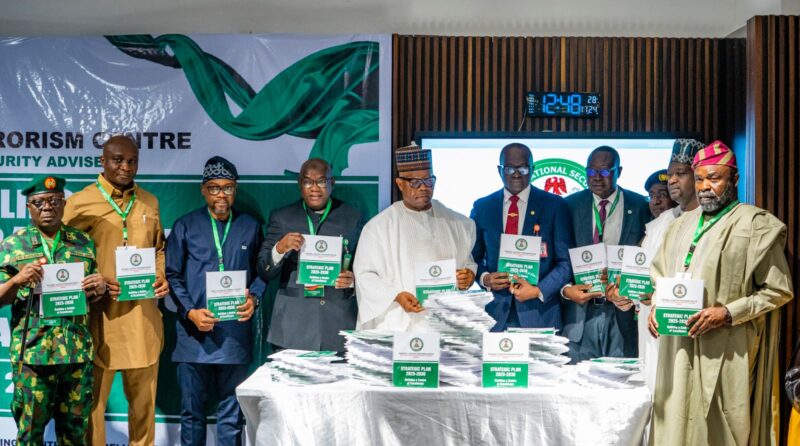
Senate president Godswill Akpabio has formally unveiled Nigeria’s counter-terrorism strategic plan for 2025–2030.
The plan was developed by the national counter-terrorism centre under the Office of the National Security Adviser (ONSA).
In his keynote address on Monday, November 24, Akpabio emphasized that the launch represents more than a policy document, it marks a defining moment in Nigeria’s national journey.
“It is a moment when Nigeria reaffirms that our people deserve to live without fear, our children deserve a future of peace, and our nation must be secured to prosper,” he said.
He highlighted the generational responsibility of securing the nation, safeguarding citizens, and putting Nigeria on a path of lasting peace, growth, and stability.
The strategic plan, he said, provides a framework for transforming institutions, modernizing security architecture, strengthening national resilience, and expanding partnerships across government, industry, civil society, and the international community.
Akpabio noted that insecurity undermines development, causing investors to withdraw, schools to close, farmers to abandon their fields, and hope to fade among young people.
He described the plan as timely, pragmatic, forward-looking, and implementation-driven.
The senate president stressed that the legislature has a constitutional duty to provide legal, budgetary, and oversight support to security institutions.
The 10th National Assembly, he said, has enacted laws enhancing defence, policing, intelligence coordination, cybersecurity, and counter-terrorism.
These efforts, he added, strengthen agency mandates, promote inter-agency synergy, and improve welfare for security personnel.
“Legislation alone cannot secure the country,” Akpabio said.
“Investments in people, technology, training, and partnerships are essential. We must replace short-term firefighting with long-term planning. That is why this strategic plan matters, it translates intent into action and action into measurable results.”
He explained that the plan adopts a whole-of-government and whole-of-society approach, recognizing that security is a shared responsibility among citizens, communities, institutions, and international partners.
In his remarks, national security adviser Nuhu Ribadu, represented by Adamu Laka, coordinator of the national counter-terrorism centre, said the plan is the result of extensive research, inter-agency collaboration, and consultations across government ministries, security institutions, academia, civil society, and international partners.
The vision is to establish the national counter-terrorism centre as a regional centre of excellence in counter-terrorism and preventing violent extremism in West Africa and the Sahel.



Comments