
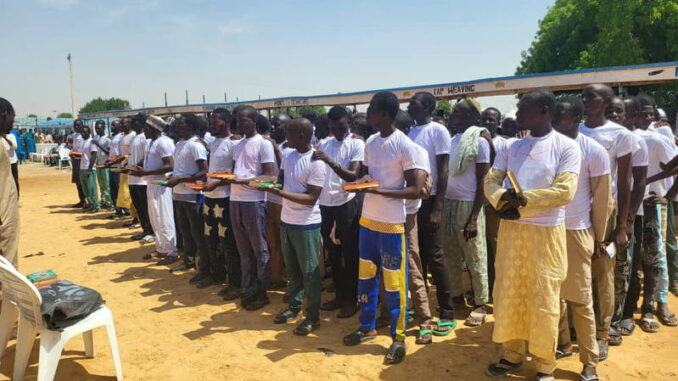
The Borno state government on Friday, June 12, reintegrated 720 repentant insurgents into their communities after they completed a deradicalisation, rehabilitation and reintegration programme under the state’s non-kinetic counter-insurgency initiative.
The beneficiaries, described as low-risk and minor clients under Batch 9 of the programme, were sworn in using the Holy Quran before being released to return to their respective communities across the state.
The ceremony took place at the Hajj Camp in Maiduguri, where government officials highlighted the progress recorded through the rehabilitation initiative introduced to encourage former insurgents to abandon violence and embrace peaceful coexistence.
Special adviser on security to governor Babagana Zulum, retired Brigadier General Ishaq Abdullahi, said the programme has become a key component of the state’s strategy for restoring peace in the north-east.
According to him, the initiative, which commenced on July 5, 2021, has encouraged thousands of insurgents to voluntarily surrender and renounce armed struggle.
He described the Borno model as one of the most successful non-military approaches to counter-insurgency, noting that more than 350,000 people have reportedly left insurgent camps and surrendered to security forces since the programme began.
Abdullahi said the latest batch brings the total number of rehabilitated and reintegrated beneficiaries across nine batches to 9,680.
He added that the programme has also catered for 992 spouses and over 2,000 other individuals who surrendered and passed through the rehabilitation process.
The security adviser explained that the reintegration process begins when insurgents voluntarily surrender to the military, after which they undergo profiling, disarmament and structured rehabilitation.
During their stay in the rehabilitation camps, participants receive religious instruction, psychological counselling and lectures on hygiene, drug abuse and civic responsibility.
They are also trained in vocational skills, including carpentry, tailoring, metal fabrication, bricklaying, barbing, cap making, pottery, solar installation, phone repairs, vulcanising and motorcycle maintenance.
According to Abdullahi, the objective is to equip beneficiaries with practical skills that will enable them to become self-reliant and contribute positively to society after leaving the camp.
The state government also provides starter packs to help them establish businesses and rebuild their lives.
Abdullahi said community leaders, members of the Civilian Joint Task Force (CJTF) and local hunters participated in screening the former insurgents before recommending them for reintegration.
The beneficiaries come from several local government areas, including Bama, Konduga, Maiduguri metropolitan council, Jere, Mafa, Dikwa, Gwoza, Damboa, Marte, Monguno, Kukawa, Ngala, Kala-Balge and Gubio.
He urged the former fighters to remain law-abiding citizens and support ongoing efforts to promote peace and development across the state.
Commissioner for women affairs and social development, Hajiya Zuwaira Gambo, represented by permanent secretary Babagana Kadai, described the programme as a symbol of reconciliation, hope and resilience.
She commended Zulum for sustaining the rehabilitation initiative, noting that the administration has continued to prioritise the resettlement of displaced persons and the rebuilding of communities devastated by years of insurgency.
The state government maintained that the programme remains an important part of its long-term strategy to foster reconciliation, reduce violence and support lasting peace in Borno state.




Comments