
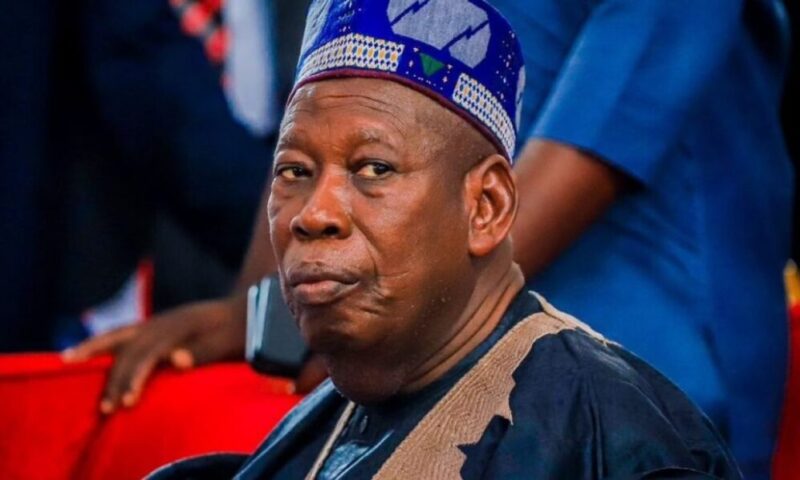
The Kano state high court on Wednesday, January 14, declined to get former Kano state governor, Abdullahi Ganduje, arrested for failing to appear before the court over the Dala Inland Dry Port Limited ownership controversy.
Ganduje and three other defendants face a 10-count charge involving criminal conspiracy, misappropriation of public funds, breach of trust, and conflict of interest.
The Kano state government charged him alongside his aide, Abubakar Bawuro; his lawyer, Adamu Aliyu-Sanda; and the former managing director of the Nigerian shippers’ council, Hassan Bello.
On Wednesday, counsel for the state government, Ya’u Adamu, told the state high court that an arrest warrant was necessary to secure the appearance of Ganduje and the other defendants, as they had failed to appear in person.
The state’s counsel applied to the court under section 388 of the administration of criminal justice law of Kano, requesting a bench warrant against all defendants for their failure to appear in the proceedings.
However, the state high court sitting at the Audu Bako Secretariat Complex, turned down the request.
The presiding judge, Yusuf Ubale, ruled that issuing a bench warrant at this stage would be premature.
Ganduje was represented by Aminu Gadanya, SAN, who, along with other defence counsel, objected to the state’s application.
They prayed the court to hear their preliminary objections before proceeding with the arraignment of the defendants.
Specifically, Ganduje filed an objection challenging the service of the court processes.
Since this is a jurisdictional issue, it must be determined before a bench warrant can be considered.
Ganduje is seeking to have the court set aside the order for substituted service, arguing that it is invalid, a nullity, and ultra vires beyond the court’s legal power.
The court granted the application to hear the preliminary objections and adjourned the matter to February 23 for a hearing.
The state government accused Ganduje and other defendants of conspiring to fraudulently transfer 80 per cent of the shares of Dala Inland Dry Port, including the state’s 20 per cent equity, to private ownership under the fictitious name ‘City Green Enterprise’.
The prosecution also claimed that the defendants diverted over ₦4.49 billion of Kano state funds to execute infrastructure projects, including a double carriageway, electricity, and perimeter fencing at the dry port, for their personal and family benefit.
The defendants also faced charges of abuse of office and conflict of interest, as it was that they leveraged their official roles to redirect public resources for personal benefit, thereby violating financial and constitutional regulations.



Comments