
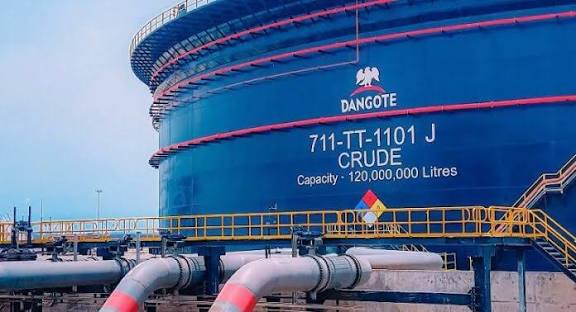
Dangote petroleum refinery has guaranteed its dedication to providing an uninterrupted supply of Premium Motor Spirit (PMS) and Automotive Gas Oil (diesel) across the country, boasting a daily production capacity that surpasses local demand.
According to Anthony Chiejina, group chief branding and communications officer of dangote industries limited, the refinery operates with a strong commitment to enhancing national energy stability and maintaining consumer trust.
Chiejina said, “Our refinery is currently loading over 45 million litres of PMS and 25 million litres of diesel daily which exceeds Nigeria’s demand.
“We are working collaboratively with regulatory agencies and distribution partners to guarantee efficient nationwide delivery.
“Dangote remains steadfast in its commitment to meeting the energy needs of Nigerians.
“This significant production capacity not only guarantees local supply but also enhances energy security and reduces dependence on imports.”
He noted that improved local production of petroleum products has helped stabilise the exchange rate and strengthen the naira.
“We have reduced foreign exchange outflows and increased inflows, which in turn supports the naira and strengthens the economy,” he added.
He further explained that it would be unpatriotic for anyone to criticise the recently announced tariff, which, according to him, is a good start.
He emphasised that the tariff is designed to protect domestic industries from unfair competition and safeguard local production.
He added, “Dumping engenders poverty, discourages industrialisation, creates unemployment and leads to revenue loss for the government.
“Across the world, nations protect their local manufacturers and industries from the threat of dumping.
“Dumping destroyed our textile industry, which was once a major employer of labour and creator of wealth.”
He noted that beyond the tariff, the government should strengthen its monitoring and enforcement mechanisms to prevent the dumping of substandard and toxic petroleum products by unscrupulous and rent-seeking individuals who prioritise profiteering at the expense of Nigerians, often undermining well-intentioned government policies for their selfish interests.
He highlighted that in previous years, widespread dumping discouraged investors from setting up industries in Nigeria, as cheap imported products flooded the market, making it difficult for local producers to compete.
According to him, the new tariff policy is expected to support domestic refiners, attract new investments in the downstream oil sector, strengthen Nigeria’s industrial base, and create additional employment opportunities.
He praised president Bola Ahmed Tinubu for implementing the tariff policy, which aims to transform and fortify the country’s downstream oil and gas sector.
The move, he said, demonstrates the administration’s commitment to fostering a stable, business-friendly environment that encourages local investment and strengthens energy security.
He noted, “President Bola Ahmed Tinubu continues to show visionary and bold leadership, restoring investor confidence and renewing hope for Nigerians.
“His administration’s reforms in the downstream oil and gas sector are opening new avenues for industrial growth and national prosperity.
“This latest policy is one of the most significant steps yet in securing Nigeria’s energy future and empowering local industries.”
He warned that failing to safeguard local industries could lead to massive dumping from Asian and European countries with surplus production capacity, which would jeopardize domestic refineries, harm allied industries, and undermine the government’s industrial growth policies.
Chiejina called on rent seekers to rethink their business practices and align with the federal government’s vision of a self sufficient energy sector, rather than promoting petroleum product dumping.
He stressed that national progress depends on shared commitment to policies that strengthen local industries and protect the economy.
With advanced technology and robust infrastructure, the refinery is expected to drastically reduce fuel import dependence, improve supply chain stability, and relieve pressure on foreign exchange reserves.
Aliko Dangote, assured Nigerians that petrol prices would remain stable during the festive ember months despite rising global prices.
“The Dangote refinery is fully committed to providing uninterrupted petrol supply throughout the festive period, ensuring Nigerians can enjoy Christmas and New Year without fuel anxiety,” he added.
Since starting petrol production in September 2024, Dangote petroleum refinery has played a key role in stabilizing prices, lowering fuel costs, and easing the burden on consumers.
It has also eliminated recurring fuel shortages and long queues at filling stations, especially during festive periods.
He noted that the average price of PMS was about N1,030 per litre in September 2024, compared to N841–N851 per litre in September 2025, following the implementation of the refinery’s direct delivery scheme.
Similarly, the pump price of Automotive Gas Oil (AGO) ranged from N1,400 to N1,700 per litre in September 2024, depending on the state, with most northern states reaching N1,700.
By September 2025, the average price had fallen to around N1,020 per litre, demonstrating the refinery’s role in stabilizing the market and reducing logistics costs.
By comparison, petrol prices in neighboring West African countries range between $1.20 and $2.00 per litre, while in Nigeria, the average remains around $0.60 per litre, highlighting the refinery’s significant impact on affordability and supply stability.


Comments