
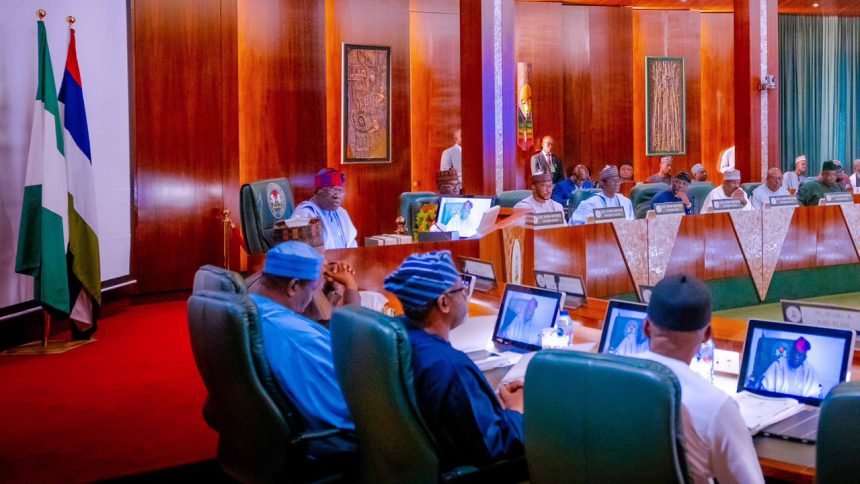
The Federal Executive Council, FEC, has given approval for over N43 billion to complete Phase II, Section II of the Lagos–Ibadan Expressway, marking another major step in advancing national road infrastructure.
Following the Council’s Thursday meeting at the State House in Abuja, the Minister of Works, Dave Umahi, announced that the new allocation is part of several ongoing and revised contracts aimed at expediting critical road projects across the country.
Providing updates on the East–West Road, Umahi explained that the administration of President Bola Tinubu inherited the project at a value of N156 billion, covering two carriageways, three flyovers, and two bridges. He said the project has now been reorganized to ensure faster delivery amid high traffic volumes and improved pavement design.
“This project was awarded about five years ago but didn’t take off. When Mr President came in, FEC terminated the earlier contract. Now, we’ve re-awarded Phase II, Section II for N43 billion. It includes underpasses, concrete pavement, ramps, and adjoining roads,” Umahi said.
The minister noted that construction on one carriageway is fully completed, with 30 per cent of work done on the second. He added that new flyovers at Abuloma and Refinery Junctions in Rivers State will be submitted for final approval before the end of the month.
Umahi stated that the revised scope also accommodates additional elements such as flyovers, underpasses, and link roads previously missing from earlier designs.
The Council further approved an upward cost review for the Mushin–NNPC Junction–Apapa–Oshodi Expressway dualisation project. Initially awarded in 2022 for N11 billion, the contract is now valued at ₦19.09 billion, accounting for inflation and higher material costs. The 14.4-kilometre project is expected to enhance transport efficiency around Lagos ports and industrial areas.
In addition, FEC approved the third section of the 1,068km Sokoto–Badagry Superhighway, covering the Badagry–Ogun–Oyo border stretch (162.97km). The project will feature reinforced concrete pavement and cost N3.39 billion per kilometre.
For the Ilorin–Omu Aran–Egba Road (206.7km), Umahi confirmed that it has been divided into manageable phases to ease funding. The first 31km phase received a ₦43 billion approval, while remaining sections will follow as funds become available.
He also revealed that Phase I of the Enugu–Onitsha Road (OP Junction–Ukehe–Okatu–Abu Udi–Oji–Anambra border), covering 35.1km, was valued at N28.47 billion, with ₦21 billion already disbursed and ₦7 billion outstanding.
In Ogun State, Section I (14km) of the Ota–Idiroko project experienced a cost revision from N43 billion to N98 billion due to the adoption of rigid pavement design and the discovery of high groundwater levels. Similarly, the associated 509-metre flyover with dual ramps was adjusted from N17 billion to N23 billion.
The FEC also approved Phase II (42km) of the Wasasa–Turunku–Mararaba Road in Kaduna State at N30.23 billion, following the earlier N18 billion approval for the initial 7.8km segment.
Another major development involves the Ijebu Igbo–Etapa–Owoyen Road connecting Ogun and Oyo States. Originally priced at N13 billion for 30km, it has been extended by 7km and revalued to N53 billion, featuring reinforced concrete and improved subgrade structures.
Umahi explained that the adjustments stem from design enhancements, tough terrain, and inflationary pressures, noting that the cost of reinforcement steel has surged to over ₦1.1 million per tonne.
He further mentioned that the governors of Edo, Delta, and Abia States have assumed responsibility for the funding and completion of select federal roads in their territories to relieve the federal government and ensure timely delivery.
“The revised approvals reflect our commitment to durable, concrete-based infrastructure that can withstand decades of use while ensuring value for money,” Umahi said.



Comments