
The Federal Government has signaled its intention to reduce the number of custodial facilities across the country, asserting that Nigeria does not require the existing 256 correctional centers.
Highlighting concerns over underutilization, the government noted that many facilities are operating at only 30 to 40 percent of their capacity. As a solution, it plans to identify inmates convicted of federal offenses and redistribute them across correctional centers, given that every state in Nigeria has a Federal High Court capable of handling such cases.
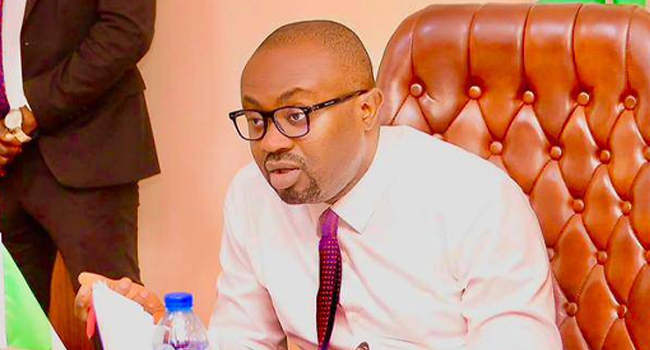
Minister of Interior, Dr. Olubunmi Tunji-Ojo, made this known on Tuesday, March 4, in Abuja during a Public Hearing on Alleged Corruption and Other Violations Against the Nigerian Correctional Service. The hearing was convened by the Independent Investigative Panel to examine allegations of corruption, abuse of power, and inhumane treatment within the correctional system.
Reaffirming the government’s stance on the humane treatment of inmates, Tunji-Ojo issued a stern warning that any form of degrading or inhumane treatment in correctional facilities will not be tolerated in 2025.
Speaking before the committee and other stakeholders, the minister challenged the status quo, questioning the necessity of maintaining so many correctional centers.
He said, “How many correctional centers do we even need? It is part of what you should cover in Nigeria.
“Realistically speaking, do we need 256 correctional centres that we have? The answer is no because the more correctional centers, the more pressure and stress in terms of supervision and control. And when there is problem of supervision and control, abuse becomes inevitable.
“So, in so many climes today, you have 3,000 capacity correctional centres. How many do we actually need? We need to look at that.
“Number three is, even with what we have today, there are some correctional centers that are densely populated or overcrowded, let me say that.
“And there are some that are not too populated. If there are criminals, if they are federal offences, there is federal jurisdiction. If I am not wrong, federal jurisdiction is everywhere, federal high court.
“So, can we critically look and analyse every correctional centre and look at those (inmates) who have committed federal offences and move them to less populated areas? Because it will shock you that there are correctional centres with about 30 percent, 40 percent occupation rate and there are some with about 200%. So how do we look at it? We think those are short-term gains that we can do like now and be able to reduce the space,” he stated.
Emphasizing the need for modernization, the minister remarked that this is 2025, not 1825, stressing the importance of conducting psychological evaluations for personnel of the Nigerian Correctional Service, NCoS.
He asserted that the true measure of any government is not how it treats the strongest, but how it cares for the most vulnerable in society.
“That is the key. It is the way you handle the weakest in the society that determines the efficiency of the government.
“For us, as a government, under the leadership of Mr President, we have decided not to toe the path of business as usual, but we have decided to make it business unusual.
“The era when a man goes into a custodial centre and all that happens is incarceration and condemnation should be gone. This is 2025. This is not 1825.
“We must treat people with respect regardless of where they are. That a man is in a correctional centre doesn’t make him less human.
“A lot of these reforms, beyond infrastructural reforms, beyond strategic reforms, have to also happen within the context of our correctional offices. The core responsibility of a correctional officer is to be an agent of rehabilitation, restoration, reformation and correction and never to be an agent of condemnation.
“That a man loses his freedom by virtue of being an inmate does not mean he should lose his dignity as a human being. It is your responsibility to protect the dignity of even the least in our society.
“When condemnation takes the place of correction, then the system must have failed. There is a huge responsibility for this committee. Responsibility number one is for you to look inwards and cure yourself of the disease or else it becomes contagious. Our correctional officers, their psyche, it is important. I think a lot of them really need psychological evaluation, without being disrespectful. Because a man who will handle a man that is already feeling deprived should be psychologically sound, and I mean that without an apology.
“There are people, even if the wives do not give them breakfast, they will go and use it to attack others. It’s the truth. If they sleep and if they go to bed unable to find sleep, the next person is the helpless person that the system and the institution is supposed to protect becomes the target. When the vulnerable, when the subject of protection becomes a target, then there is a problem, and that is where we are,” he said.

Share this:
- Click to share on WhatsApp (Opens in new window) WhatsApp
- Click to share on Facebook (Opens in new window) Facebook
- Click to share on X (Opens in new window) X
- Click to share on Telegram (Opens in new window) Telegram
- Click to share on Pinterest (Opens in new window) Pinterest
- Click to print (Opens in new window) Print
- More




Comments