
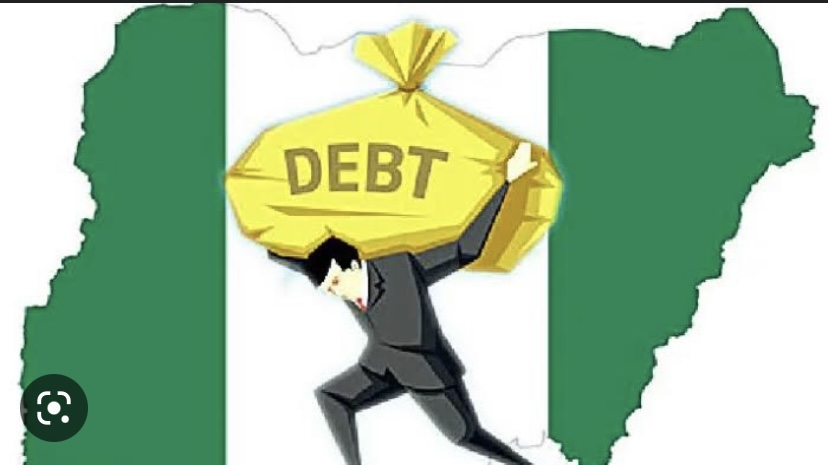
Nigeria’s petroleum subsidy payments and government’s borrowings to fund budget deficits would see President Muhammadu Buhari leave a huge debt of N77 trillion for the incoming administration in May 2023.
The incoming administration is nothing to be envious of as too much debts is currently plaguing Nigeria.
We recall that Nigeria’s public debt stock rose from N35.46 trillion (US$86.57 billion) in the second quarter of 2021 to N42.84 trillion (US$ 103.31 billion) in the second quarter of 2022.
The Director-General of the Debt Management Office (DMO), Patience Oniha, said the debt had been growing because of new and constant borrowings.
To compare between the former president, Goodluck Jonathan’s administration and the leaving administration under president Buhari will leave one in awe.
However, the former Minister of Finance, Ngozi Okonjo-Iweala, spoke in defence of Mr. Jonathan’s administration, saying that the administration only incurred $21.8 billion.
The leaving government administration under president Buhari has secured more depts than any other administration. Which is a very bad record because things ought to have been done in a better way.
Experts complain
Despite warnings from experts and organisations, the Federal Government has kept borrowing from the CBN to fund budget deficits
Also, the N22.07tn owed the apex bank by the Federal Government is not part of the country’s total public debt stock, which stood at N42.84tn as of June 2022.
Experts have kicked against the Federal Government’s proclivity for debt, which they have described as unsustainable.
An Abuja-based policy think tank, Agora Policy, said Nigeria’s debt was unsustainable and put the country in a perilous situation due to the high cost of debt servicing.
A former President of the National Accountants of Nigeria, Dr Sam Nzekwe, agreed that Nigeria’s debt was unsustainable
He said, “The debt is huge. If you look at the budget, you will see that a huge sum of money is used to service debts. This is just the debt service charge. We are yet to talk about the principal.”
He further noted that the country had a revenue problem.
A development economist, Dr Aliyu Ilias, criticised the government for its constant reliance on borrowing, which was not healthy for the economy.
He said the federal government keeps borrowing to the detriment of its citizens. As debts not paid would yield mayhem.
Lawyers condemn FG
Some legal practitioners have condemned the action of the Federal Government regarding the borrowings beyond the level stipulated by law.
They say such action is troubling and threatens the sovereignty of the country.
Speaking on the issue, Kunle Adegoke, SAN, said there was no reason behind the action of the government.
He said that by the country’s monetary policy, there is a limit to which a government can borrow. The government cannot borrow in excess of 50 per cent of its income, and looking at the income of Nigeria as of today, there is no rationale for the level of borrowing the government has gone into.
He added that in international economic law, there is what is ‘call sovereign insolvency’. There are nations that have suffered that before. The most recent is the case of Greece.
He further warned that Nigeria may not continue to be that lucky. As things are right now, the country seems to be going on auto-pilot.
Another lawyer, Daniel Makolo, condemned the actions of the government, adding that it was guilty of treason.
He said, that the CBN Act has a section where the Federal Government should not borrow more than a certain percentage of its income from the CBN and when they deliberately violate that, they have violated the constitution and the extant laws setting up of the Federal Republic of Nigeria.
He added that Nigerians now hear where the servicing of debt is not only at 30 per cent, but is far more than that; it now means that FG has deliberately sold and mortgaged the entire Nigeria into servitude and slavery.
He also said that FG sold the sovereignty of the country, including the people in it, their property and whatever they have, which they have a contract to protect.
He concluded that the government and those who take part in borrowing more than stipulated have committed not just an impeachable offense , but treason by abusing the public trust bestowed upon them to protect and preserve the people.
World Bank narrates how borrowing weakens the fiscal position of Nigeria
The World Bank has said that high borrowing costs, lower energy prices, slow growth in oil production and subdued oil-sector activity weaken Nigeria’s fiscal position.
The Washington-based bank also said that Nigeria’s growth weakened to 3.1 per cent in 2022 and will further decelerate to 2.9 per cent this year.
This was according to the latest Global Economic Prospects report by the World Bank on Tuesday.

The bank noted that a number of factors, such as low oil output, insecurity, petrol subsidies, forex scarcity, among others, hamper growth in the country.
“A strong recovery in non-oil sectors moderated in the second half of the year as floods and surging consumer prices (annual inflation surpassed 21 per cent for the first time in 17 years) disrupted activity and depressed consumer demand. Persistent fuel and foreign exchange shortages, with the naira depreciating by over 30 per cent last year in the parallel market, further dampened economic activity.”
The report added, “In Nigeria, growth is projected to decelerate to 2.9 percent in 2023 and remain at that pace in 2024—barely above population growth. A growth momentum in the non-oil sector is likely to be restrained by continued weakness in the oil sector.
“Existing production and security challenges, and a moderation in oil prices are expected to hinder a recovery in oil output.
“Policy uncertainty, sustained high inflation, and rising incidence of violence are anticipated to temper growth. Growth in agriculture is expected to soften because of the damage from last year’s floods.
“The fiscal position is expected to remain weak because of high borrowing costs, lower energy prices, a sluggish growth of oil production, and a subdued activity in the non-oil sectors.”
The bank also said that debt sustainability and investor sentiment deteriorated further in many other countries, leading to rising borrowing costs and credit rating downgrades like in the case of Ghana and Nigeria.
It added that increased insecurity has worsened fragility and is expected to reduce access to food for many more people across the region, further weighing on economic recoveries.
In conclusion, the leaving administration under president Muhammadu Buhari has done more harm than good in Nigeria and to Nigerians. The incoming administration has more to do or else Nigeria will seize to exist or it’s citizens will continue to anguish in suffering.





Comments