
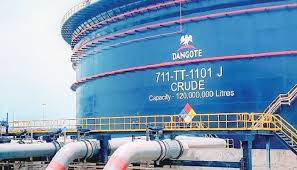
Ghana is advocating for a unified currency among members of the Economic Community of West African States (ECOWAS) to facilitate procurement of petroleum from the Dangote petroleum refinery.
Mustapha Abdul-Hamid, Chairman of the National Petroleum Authority (NPA) in Ghana, made this statement during the ongoing Oil Trading and Logistics (OTL) Africa Downstream Energy Week that will span through Monday, October 28 to Thursday, October 31 in Lagos, Nigeria.
The NPA chairman argued that Africa’s heavy reliance on the dollar was placing excessive strain on local currencies, resulting in a loss of value.
He pointed out that Ghana requires dollars to import fuel from the Dangote refinery, and Nigeria would similarly need dollars for any imports from Ghana, calling this situation nonsensical.
Regarding collaboration and partnerships in the petroleum sector, Abdul-Hamid emphasized that while member states may have varying political interests, it is essential in the spirit of ECOWAS to align these interests into a shared agenda that enables mutual benefit from each other’s markets.
Fortunately for us, the entire continent now has an Africa Continental Free Trade Agreement (AfCFTA) that allows us to collaborate among ourselves in terms of trading, not just in petroleum products but in all other products.
However, if Ghana is going to import petroleum products from Dangote refinery, for example, we would still have to pay Dangote refinery in dollars.
“If there is a petroleum shortage in Nigeria, then you would have to supplement with imports from the Gold Coast refinery in Accra; for example, you would also have to find dollars to still buy from Ghana.
“To an extent, that doesn’t make a lot of sense to me.
“Therefore, we should move to a point whereby we actualise this goal of having a common currency for all of us.
“It is our demand for dollars to import petroleum products that put pressure on our various currencies.
“That drives petroleum product prices upwards.
“Now that Nigeria has a deregulated petroleum regime, for example, the major factor that is going to be responsible for driving up petroleum prices in Nigeria will be the currency, because importers would need more dollars to import petroleum products,” Abdul-Hamid stated.
He noted that Ghana would need $400 million each month to import petroleum products.
Adding that, “Now I can imagine how much Nigeria will need for the importation of its petroleum products.
“Where are the Nigerian petroleum importers going to find the dollars?
“You will only put too much pressure on your currency.”
He urged for alliances that extend beyond mere collaboration among petroleum authorities to genuine cooperation at the governmental level, aiming to harmonize petroleum infrastructure and fiscal and economic policies.
Abdul-Hamid mentioned that Ghana is eager to import petrol from the Dangote refinery once it reaches a capacity of 650,000 barrels per day(bpd), as Nigeria would not be able to consume the entire output.
He noted that this arrangement would be preferable to importing refined petroleum products from Rotterdam in the Netherlands.
The NPA chairman revealed that the country has implemented measures to prevent fuel smuggling from Nigeria into Ghana, urging the Nigerian Midstream and Downstream Petroleum Regulatory Authority (NMDPRA) to establish a security unit for this purpose.
Aliko Dangote, the President of the Dangote refinery, has encouraged local marketers to source petrol domestically rather than importing it from abroad.
He stated that the company had around 500 million litres in storage while the Nigerian National Petroleum Company Limited (NNPCL) and others were seeking premium motor spirit from alternative sources.





Comments