
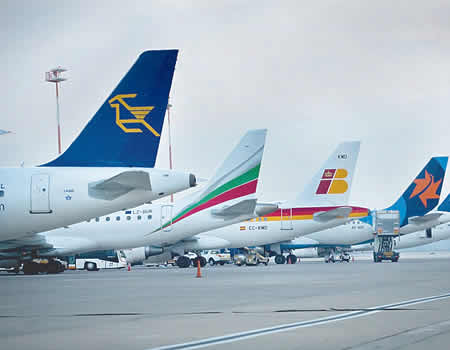
International airlines flying into Nigeria incur annual costs of approximately N25 billion for towing their aircraft due to the unavailability of functional aero bridges at the country’s major airports.
The Federal Airports Authority of Nigeria, FAAN, has failed to import 28 aero bridges procured since 2014, forcing airlines to rely on ground handling companies for aircraft movement.
Unlike in developed countries, where aero bridges align seamlessly with aircraft doors for swift passenger embarkation and disembarkation, Nigerian airports require aircraft to be towed to the bridges before passengers can exit. This not only results in hefty towing fees but also causes delays of about 20 minutes for travelers upon landing.
An aero bridge, also known as a jetway or air bridge, is a movable corridor that connects an airport terminal directly to an aircraft, enabling safe and efficient boarding. However, despite the procurement of these structures from China over a decade ago, they have yet to be imported and installed.
Data from FAAN indicates that the international runway of Murtala Muhammed Airport in Lagos handles approximately 990 aircraft movements monthly, with 11,880 aircraft taking off and landing annually. Airlines pay $1,350 per tow for large aircraft and $673 for smaller ones.
Based on these figures, airlines collectively spend around $16 million (N25 billion at the current exchange rate of N1,534 per dollar) on towing services each year.
Former Managing Director of the Nigerian Airspace Management Agency, NAMA, Roland Iyayi, criticized the situation, suggesting that ground handling companies might be benefiting from FAAN’s failure to install the automated bridges. He emphasized that this inefficiency has placed an unnecessary financial burden on international airlines operating in Nigeria.
“For me, I see what is happening as a sort of connivance by some people to make money for the ground handling companies. Just like the case of the generating set companies/sellers and NEPA, because when NEPA refuses to supply power, generator companies will sell more.
“Now that the authorities have refused to provide the automated machine, the ground handling companies have a job to do, one that shouldn’t have surfaced at all,” he stated.
Iyayi, however, urged FAAN to take necessary measures to alleviate the financial strain on airline operators.


Comments