
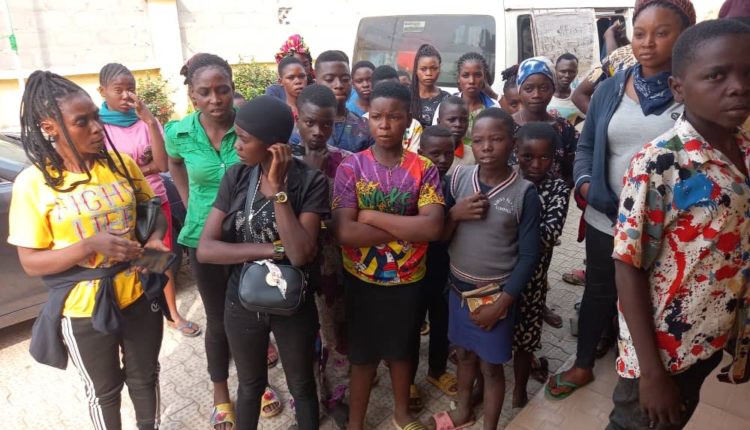
Last weekend, two incidents in Benue State highlighted a menace of the Nigerian society, human trafficking.
A total of 38 young persons, both male and female, suspected of being trafficked were intercepted in separate incidents in the state.
In one of the incidents, a lady was intercepted with six girls within the range of 16-24 years travelling from Duku Motor Park in Markurdi to Lagos State.
In the incident which happened on Friday, January 7, 2022, N500,000 was found on the suspect alongside some foreign currencies which raised the suspicion that the victims were to be moved to a destination outside the country.
As if to further spolight the issue of trafficking, the next day, the Benue State Police Command intercepted two buses loaded with 32 young girls and boys at Ameladu area of Gboko local government area of the state.
The young people were made up of 13 boys and 19 girls with the oldest being about 25 years.
Although less reported, human trafficking according to the Nigeria Immigration Service in 2016 is the third most profitable illegal business in the country after drugs and gunrunning.
To elaborate on the extent of human trafficking in Nigeria, it is important to x-ray the various forms in which it exists because usually, the average Nigerian only considers selling or sending girls abroad for illicit business as human trafficking.
Just as the United States report on Human trafficking in Nigeria reveals traffickers exploit domestic and foreign victims in Nigeria.
The report revealed that internal trafficking is prevalent with Nigerian perpetrators recruiting victims from rural areas, especially the country’s southern regions, for exploitation in commercial sex and forced labour in domestic work in cities such as Abeokuta, Calabar, Ibadan, Kaduna, Kano, Lagos, and Port Harcourt.
In other words, exploitation of girls in domestic service as well as boys in forced and bonded labour in street vending, domestic services, artisanal mining, stone quarrying, agriculture, textile manufacturing, begging, etc all fall under human trafficking.
Another form in which human trafficking exists in Nigeria is child harvesting popularly called baby factory.
Yes, illegal baby factories are still operating in Nigeria, in fact, according to reports, the numbers of these factories are increasing.
Oftentimes, these factories disguise themselves as private medical clinics, orphanages, social welfare homes, or even churches.
In September last year, The Street Journal reported how the Imo State Police Command uncovered a popular church, Jesus Life Assembly located at School Garden, Uratta in Owerri North LGA of the state was being used as a baby factory.
The pastor in charge, Evangelist Ugochi Orisakwe who was arrested with four other accomplices confessed to using the church as a place where young girls are kept, impregnated and after delivery, the girls are paid off and their babies sold to rich and childless clients.
The baby factory business is such a dirty and profitable business.
A report by Al Jazeera found that in some of these baby factories, the going rate for baby boys was between N700,000 to N1million while baby girls were sold for prices between N500,000 and N700,000.
It is the reason why the operators of such factories are usually mean and ruthless.
Sometimes, the ladies are even kidnapped and raped and the babies forcefully taken from them.
In December last year, a lady bitterly recounted how she and her friend who were lured with a fake Italian job offer ended up in one of such dens where they were constantly being raped to produce babies that were forcefully taken from the mothers and sold.
For traffickers who feel they do not want the rigours of operating such factories, they outrightly move about stealing babies and children from unsuspecting mothers and family members.
The age of the targetted children could vary from newly born babies to seven years.
Last November, a vigilante group in Ebonyi intercepted two women who had stolen two newborn babies, concealed them in sack bags and were en route to Lagos where they intended to sell the babies.
Another form of trafficking that is now making waves is the direct sale of children by their parents themselves.
As sad as it is, parents now sell their own children for money to traffickers, sometimes at ridiculous and heart-breaking prices.
Only last month, many Nigerians were in shock when it was reported that a couple in Ogun State sold their weeks’ old baby for N50,000.
In 2014, a woman was arrested in Bayelsa was arrested after she sold her day-old baby for just N20,000.
These incidents show one of the reasons why human trafficking is very successful in Nigeria, poverty.
When the couple in Ogun State was arrested, they argued that they could not fend for the baby hence they decided to sell when the buyers offered them the N50,000.
Human traffickers have positioned themselves to exploit the harsh economic situations in the country.
They form syndicates and their members are strategically placed to identify these poor baby owners after which they offer them sums of money and collect the baby.
The case of a single mother of five who sold her newborn baby for N400,000 in Ebonyi is a glaring example of how these syndicates operate.
Two other persons, a staff of Alex Ekwueme Federal University Teaching Hospital and the principal Nurse, at the hospital’s annex at Nwezenyi, in the Izzi Local Government Area were also arrested in the incident.
It was the nurse at the hospital annex in the local medical centre where the lady attended antenatal who identified her and exploiting her financial situation, bought the baby from the mother.
The baby was then transferred to the staff at the hospital in the state capital where it was recovered before it was sold to the real buyer.
Traffickers are also known to use the allure of living and working in big cities and international countries, especially when they recruit unsuspecting victims from rural areas after which such victims are used for exploitative domestic work, farm labour or prostitution.
With internal trafficking being fuelled by urbanization and economic crises, it is a complex and difficult issue to tackle.
The Trafficking in Persons (Prohibition) Enforcement and Administration Act of 2015 which explicitly criminalised human trafficking as well as other related abuses and stipulated a sentence of at least seven years and a fine of no less than N1 million, though a step in the right direction cannot alone combat the menace.
This is because it does nothing to address the root cause of the prevalence of human trafficking in Nigerian society.
That said, the efforts of the National Agency for the Prohibition of Traffic in Persons (NAPTIP) which has been on the fire front in the battle against trafficking in Nigeria must be commended however, the agency obviously faces a lot of challenges.
For starters, the shallow perception of what trafficking really is makes it difficult to identify and provide needed services, assistance to victims.
There is also the lack of an enabling environment to tackle human trafficking which is observed in the lack of funding in anti-trafficking activities, lack of equipment and facilities and lack of data on human trafficking in Nigeria.
Thankfully, in the past few years, federal and state governments in reaction to some damaging reports by foreign media outlets have ratified or acceded as a signatory to a number of international conventions which are directly or indirectly related to trafficking.
The same energy should be channelled towards tackling internal trafficking also.
As already established, trafficking of human beings in Nigeria is rooted in poverty and the desire of poor people to migrate in search of better opportunities and as such, any realistic approach towards stopping it must start at the grassroots.
Federal and state governments, agencies should enhance community capacity to combat trafficking.
Just as the International Labour Organization ILO posits community-led activities such as direct involvement of local institutions and traditional leaders in the identification of human traffickers and implementation of measures against will be an important prevention tool in action against human trafficking.
Community Vigilance Groups (CVG) led by traditional rulers, religious and community leaders can mobilize community members in rural areas to detect and prevent human trafficking.
Also, sensitization of the society to understand the concepts of forced labour and trafficking; as it will help individuals identify situations of trafficking and forced labour without further traumatizing victims.
Furthermore, specific attention should be paid to the needs of trafficked children.
There should be no delusion, there is no quick fix to eliminating human trafficking. It is a process that involves a collaborative partnership between all aspects of the society from the government to the people.




Comments