
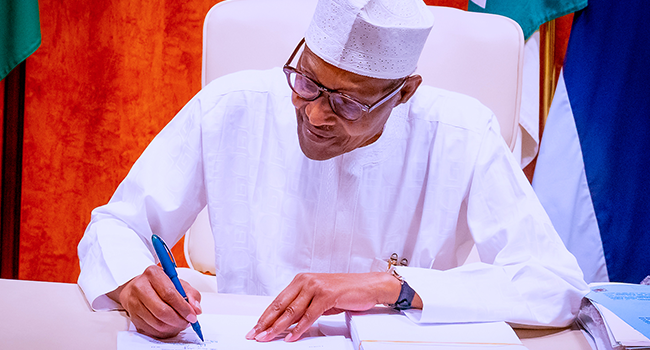
President Muhammadu Buhari today, 25 February, finally signed the Electoral Act Amendment Bill into law.
The President assented to the bill at a brief ceremony held at the Council Chamber of the Aso Villa in Abuja.
In view of the 2023 general election, the Electoral Act Amendment Bill which has just been passed into law stipulated some top provisions in conducting the election.
According to the bill, INEC’s scheduled date for the 2023 general election is February 18, 2023.
The provisions for the general election in the bill states: “Early release of election funds to INEC. To strengthen the financial independence of INEC by ensuring that all funding required for a general election is released not later than one year before the general elections.”
“Gives room for the electronic transmission of election results. Allows INEC to determine if election results are transmitted electronically or manually.”
The provision gives “INEC the power to review declarations and returns made under questionable circumstances to keep Returning Officers in check. Fundamentally transform the results management process and deter politicians from compelling election officials to declare fabricated election results that can only be challenged in court.
“A person who, being a member of a political party, misrepresents himself by not disclosing his membership, affiliation, or connection to any political party in order to secure an appointment with INEC in any capacity, commits an offence and is liable on conviction, to a fine of N5,000,000 or imprisonment for a term not exceeding two years or both.
“electronic accreditation of voters using the Smart Card Readers or any technological device as may be determined by INEC.
“Mandates INEC to ensure that persons with disabilities, special needs, and vulnerable persons are assisted at the polling place by the provision of suitable means of communication, such as Braille, large embossed print, electronic devices, sign language interpretation, or off-site voting in appropriate cases.”
The bill states that “Overvoting occurs when the number of votes cast at an election in any polling unit exceeds the total number of accredited voters in that polling unit. Therefore, total number of accredited voters, will become a determining factor in the validity of votes in an election.
“Every political party shall, not later than 180 days (6 months) prior to election day, submit the list of its candidates, who must have emerged from valid primaries conducted by the political party, to INEC
“Public campaigns by political parties have been extended from 90 days to 150 days before polling day and end 24 hours prior to that day.
“Affords political parties the opportunity to conduct primary elections to replace a candidate who dies after the commencement of polls and before the announcement of final results and declaration of a winner. A timeline of 21 days is provided for INEC to conclude an election and declare a winner.
“In the case of legislative elections, the election will start afresh, and a political party affected by the bereavement can conduct a new primary within 14 days to nominate a new candidate. However, in the case of presidential and governorship elections, the running mate of the deceased candidate will continue with the election and nominate a running mate.
“INEC is required to issue a notice of election not later than 360 days before the day appointed for an election. According to INEC, the scheduled date for the 2023 Presidential and National Assembly election is February 18, 2023.”






Comments