
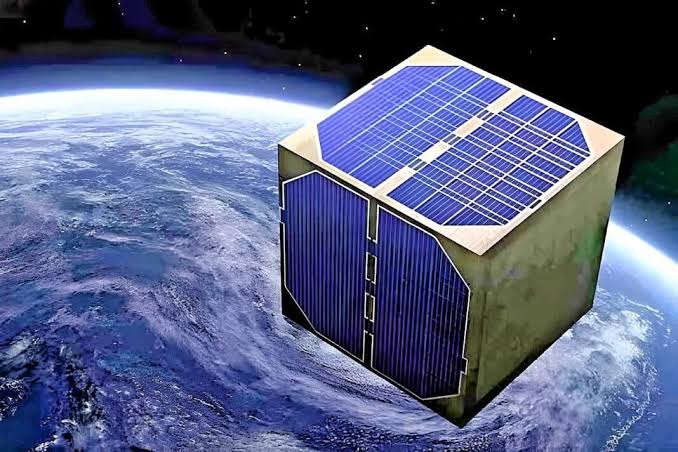
The world’s first wooden satellite, created by Japanese researchers, was launched into space in the early hours of Tuesday, November 5 as part of an initial test to explore the use of wood in lunar and Mars missions.
The wooden satellite which was named LignoSat, was developed by Kyoto University and the construction company Sumitomo Forestry, will be sent to the International Space Station aboard a SpaceX flight.
From there, it will be deployed into orbit approximately 400 km approximately 250 miles above the Earth.
LignoSat, which derives its name from the Latin word for “wood,” is designed to test the potential of this renewable material for future space exploration and habitation.
“With timber, a material we can produce by ourselves, we will be able to build houses, live and work in space forever,” Takao Doi, an astronaut who has flown on the Space Shuttle and studies human space activities at Kyoto University, said.
As part of a 50-year plan to plant trees and construct wooden houses on the Moon and Mars, Doi’s team chose to create a NASA-certified wooden satellite to demonstrate that wood can be a viable material for space use.
According to the researchers, a wooden satellite also reduces environmental impact when it reaches the end of its life.
Decommissioned satellites are required to re-enter the atmosphere to prevent becoming space debris.
While traditional metal satellites release aluminum oxide particles during re-entry, wooden satellites would simply burn up with minimal pollution.
“Metal satellites might be banned in the future.
“If we can prove our first wooden satellite works, we want to pitch it to Elon Musk’s SpaceX,” Doi further stated.
After a 10-month experiment aboard the International Space Station, researchers determined that honoki, a type of magnolia tree native to Japan and traditionally used for making sword sheaths, is the most suitable wood for spacecraft.
LignoSat is crafted from honoki using traditional Japanese techniques, without the use of screws or glue.
Once deployed, LignoSat will remain in orbit for six months, with onboard electronics monitoring how the wood withstands the harsh conditions of space, where temperatures swing from -100 to 100 degrees Celsius every 45 minutes as it moves between darkness and sunlight.
According to Kenji Kariya, a manager at Sumitomo Forestry’s Tsukuba Research Institute, LignoSat will also assess wood’s potential to shield semiconductors from space radiation, which could make it valuable for applications like data center construction.
“It may seem outdated, but wood is actually cutting-edge technology as civilisation heads to the moon and Mars.
“Expansion to space could invigorate the timber industry,” He said.






Comments