
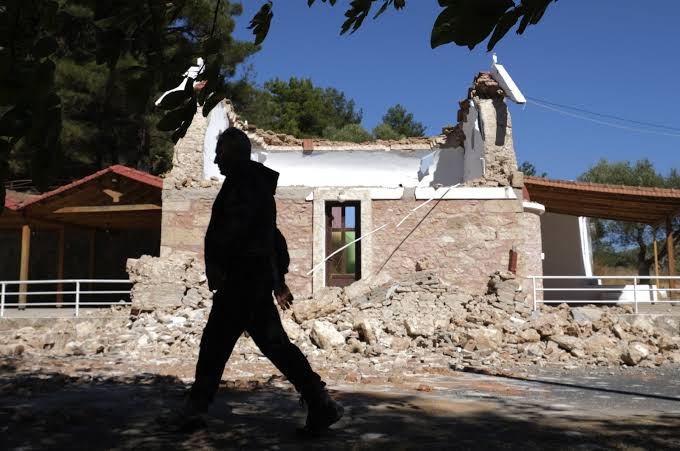
An earthquake with an initial magnitude of at least 5.8 struck the Greek island of Crete on Monday morning, killing one person and injuring several others, while damaging homes and churches and causing rock slides near the country’s fourth-largest city.
The quake sent people fleeing into the streets in the city of Heraklion, and schools were evacuated. Repeated aftershocks rattled the area, adding to damage in villages near the epicenter.
“The earthquake was strong and was long in duration,” Heraklion mayor Vassilis Lambrinos told private Antenna television.
The Athens Geodynamic Institute, which gave the 5.8 magnitude, said the quake struck at 9:17 a.m. (0617 GMT), with an epicenter 246 kilometers (153 miles) south southeast of the Greek capital, Athens.
Hospital officials said 20 people had been treated for injuries, ten of them receiving first aid.
International and domestic flights to Heraklion airport weren’t affected by the quake, while the region’s hoteliers association said there was no serious damage to any hotels in the area, which includes many popular holiday resorts.
Municipal construction vehicles helped clear a path for the emergency services, scooping up rubble and knocking down a badly damaged apartment block balcony.
“This is not an event that occurred without warning. We have seen activity in this region for several months. This was a strong earthquake, it was not under sea but under land and affecting populated areas,” seismologist Gerasimos Papadopoulos said on Greece’s state broadcaster ERT.
The European-Mediterranean Seismological Center and the U.S. Geological Survey put the preliminary magnitude of 6.0, with an epicenter seven kilometers (four miles) north of the village of Thrapsano. It is common for different seismological institutes to give varying magnitudes for an earthquake.
Greece’s Climate Crisis and Civil Protection Ministry confirmed to CNN that one man had been killed. He was pulled from the rubble of a partially collapsed church very close to the epicenter, authorities said. Local media said the victim was a 65-year-old builder who had been working inside the church when the roof collapsed on him.
Civil protection officials said tents were being set up for residents whose homes had been damaged, and there would be capacity for up to 2,500 people.
“We are urging people who live in damaged older buildings to remain outdoors. One aftershock can cause a collapse,” Seismologist Efthimios Lekkas said from Crete. “We are talking about structures built before 1970. Structures built after 1985 are built to a higher standard that can withstand the effect of an earthquake.”
Greece lies in one of the most seismically active parts of the world, but strong quakes that cause extensive loss of life or widespread damage are rare. In 1999, an earthquake just outside Athens killed 143 people.
The earthquake is the third to hit the world with a magnitude higher than 5.5 in the past week. The first being Australia then Phillipines and now, Greece.





Comments