
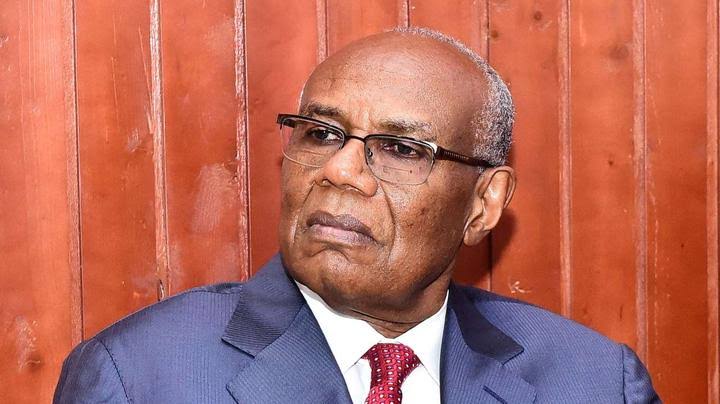
A former Group Executive Director of the Nigerian National Petroleum Company Limited, NNPCL, Alex Ogedengbe has said the rehabilitation of the Port Harcourt refinery is not economically feasible.
Ogedengbe made this known on Monday, December 5, saying much should not be expected from the refinery.
It will be recalled that the NNPCL boss, Mele Kyari disclosed recently that the refinery in Port Harcourt will resume operations by December 2023, but emphasizing that the refinery from all indications would not work by the period given by NNPCL, Ogedengbe maintained that if at all the refinery resumes operation, it would not produce more than 25 percent of petrol per barrel of crude oil.
Ogedengbe was the former Managing Director of both the Kaduna and Port Harcourt refineries.
The former NNPCL Group Executive Director stated that the old refinery NNPCL had decided to repair, had not worked for over 30 years.
“If what I heard from that short, nine-minute release by the MD of the refinery is anything to go by, at best they will have some kind of mechanical completion by the end of December, because he said they are 75 percent done overall, but 98 percent done on procurement.
“But by end of December (2023), at best, they will have mechanical completion, then they will do the testing of each equipment and systems.
“You test one equipment, you see how it fits with another one. Then you put everything together as a system. The system tests may take anything from two weeks to one month before you can start, in my opinion, based on what he said.
“I don’t think it can be done more than within two or three months. Now, what you will get there again, is something like the old refinery of 60 years ago with just new equipment. The capacity is still 60,000 barrels per day.
“The old refinery that is being repaired now, cannot produce more than 25 percent maximum of crude oil. In other words, one barrel of crude will produce a maximum of 25 percent of petrol. Whereas, the newer Port Harcourt refinery which is next door to the old one they are repairing can produce up to 48 percent or 50 percent on crude oil.
“So, overall, I don’t expect any appreciable contribution. That is even if all the systems work. I don’t have confidence in that right now from what I’ve seen,” he stated.
Ogedengbe revealed that in October 2023, during an engineers’ fellows’ meeting made up of at least three former MDs of NNPCL refineries, they were not allowed to visit as the scheduled event was cancelled in the last minute.
He went back to the early 1990s when he was in charge of the facilities, saying there was no need to import products as all the refineries which were working at the time have now shut down.
Ogedengbe argued that if he was told that there was a proper plan to get the refineries from zero production to 100 percent 10 years before now, he would not be in doubt, but not now with the extent of damage at the refinery.
The former Group Executive Director of NNPCL wondered why company did not pick the newer 150,000 barrels per day facility which was built 30 years later and is beside the 60,000 barrels per day built almost 60 years ago.
“The old refinery, the one that was built in 1965, that’s about 58 years ago, has not operated since 1990 when the new refinery came on. So, it’s been shut down,” he disclosed.
Ogedengbe recalled that he was the project manager when the new refinery in Port Harcourt was built between 1985 to 1990, stressing that the new one is a more complex and modern facility and should have been fixed first.
“If you put one barrel of crude oil into the new one, 48 to 50 percent of it will be petrol. The old refinery, if you put one barrel of crude oil into it, you only get maximum 23 to 24 per cent of petrol, which shows the complexity.
“The old refinery has just one conversion unit that can produce petrol. The new refinery has four different conversion units. That is the issue. Why is this old refinery being rehabilitated instead of the new one?
“The old refinery was built in 1965 with a different old technology. Now what is being done there? “ he asked, stressing that rather than rehabilitation as Nigerians have been told, it was actually being reconstructed.
Ogedengbe revealed that testing each functional part of the refinery alone, if any part of it works, will take at least three months to achieve, which according to him implies that the refinery cannot begin operation in December.
“There is no way we can justify the situation we have today. The refineries were built according to international standards. They were all tested for completion and they performed at the time they were completed.
“They ran according to the design for many years. However, being a government-owned facility, not a private one, they were not run commercially.
“What does that mean? Monies did not come in time for maintenance. Not enough money actually was given for maintenance and it was not a profitable project. So it was just declining slowly because of lack of maintenance until it crashed. All of them crashed by 2018,” he stressed.
Speaking further, Ogedengbe said that although during his time, money was usually budgeted for maintenance, but they were never fully released by the NNPCL.
He revealed that the Kaduna and Port Harcourt refineries when he was still the managing director, went out of its way to begin the production of tins and drums to survive.
“Every month, we will receive between 50 and 60 percent of our budget. We are supposed to pick up the rest somehow. You have to be imaginative.
“When I was in Kaduna refinery for instance, it was the only refinery that had a tin and drum manufacturing plant, which is not typically a refinery thing, but we had that plan because we were producing kerosene and we were selling in tins.
“So I was selling ordinary tins and drums to people who were buying them for water and other uses to augment the budget for the refinery operations,” he said.
Ogedengbe made known his surprise that a 58-year-old refinery will be selected over the one that was built 30 years later, stressing that the guess is that the NNPCL wanted to do what he described as a quick fix politically
He noted that it was the reason the original contractor of the newer Port Harcourt refinery had chosen not to participate in the current rehabilitation process.
“They did not think that was the right way to go,” he said.





Comments