
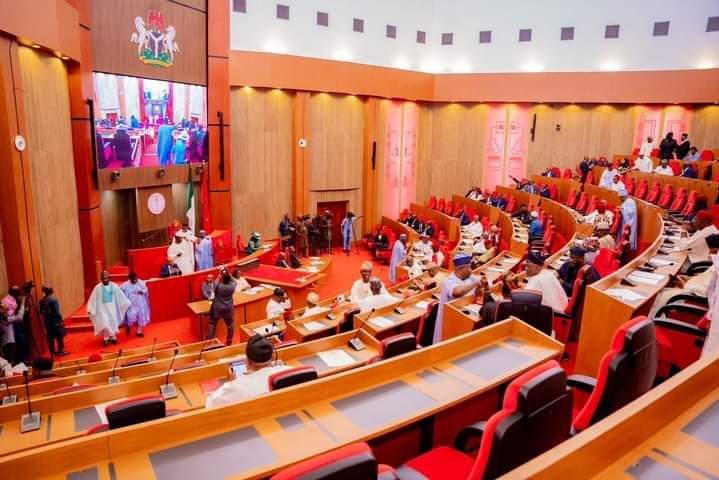
The Senate has commenced debate on the 2026 Appropriation Bill, marking the start of legislative scrutiny of the Federal Government’s proposed spending plan for the coming year.
Leading the debate on the floor on Tuesday, Senate Leader Opeyemi Bamidele outlined the scope and intent of the fiscal proposal, which seeks approval for a total expenditure of ₦58.47 trillion for the 2026 financial year.
He explained that the Bill provides the statutory basis for implementing the budget earlier presented by President Bola Tinubu to a joint sitting of the National Assembly on December 19.
Bamidele told lawmakers that the Bill was automatically regarded as having passed first reading following the President’s presentation, in line with legislative procedure.
“Distinguished Colleagues, I rise to lead the debate on a Bill for an Act to Authorise the Issue from the Consolidated Revenue Fund of the Federation the total sum of ₦58,472,628,944,759 for the services of the Federation for the year ending 31st December, 2026, as presented by Mr President to a Joint Session of the National Assembly,” Bamidele said.
He described the Appropriation Bill as a core instrument of governance, noting that it converts the policy objectives outlined in the President’s budget speech into legally binding public expenditure.
Setting out the economic context, the Senate Leader said the 2026 Budget was developed amid ongoing reforms targeted at stabilising the economy, addressing structural weaknesses and strengthening public finances.
“The 2026 Budget is therefore not an experimental document. It is a budget of consolidation—consolidating reforms already undertaken, stabilising key economic indicators, and accelerating growth through targeted public investment,” he stated.
According to Bamidele, the proposed ₦58.472 trillion spending plan includes ₦4.097 trillion for statutory transfers, ₦15.909 trillion for debt servicing, ₦15.252 trillion for recurrent expenditure excluding debt, and ₦23.214 trillion earmarked for capital projects through the Development Fund.
He said the allocation pattern demonstrated clear priorities, with capital spending accounting for the largest share of discretionary expenditure.
“Capital expenditure remains the single largest component of discretionary spending, underscoring the administration’s commitment to growth, productivity, and infrastructure development,” he said.
Bamidele described the ₦23.214 trillion capital vote as the foundation of the 2026 Budget, with investments targeted at transport networks, power and energy, agriculture, industrial growth, housing and the digital economy.
“As the President emphasised, sustainable growth cannot be achieved without addressing infrastructure deficits and expanding the productive capacity of the economy,” Bamidele noted, adding that the spending was expected to drive private sector investment, job creation, and improvements in food and energy security.
On recurrent spending, he said the ₦15.252 trillion provision would support day-to-day government operations, including salaries and overheads, while assuring senators that efficiency measures and cost controls would be strictly enforced.
Addressing debt obligations, Bamidele said the ₦15.909 trillion set aside for debt service reflected existing commitments, while reaffirming the government’s intention to boost revenue generation and gradually cut back on borrowing.
“This Senate will continue to exercise its oversight responsibility to ensure that borrowing remains prudent and that debt is deployed strictly for development purposes,” he said.
He also drew attention to the ₦4.097 trillion allocated to statutory transfers, saying the funds were necessary to meet constitutional requirements and support the independence and stability of key national institutions.
Bamidele called on senators to examine the Bill with diligence and a sense of national duty, stressing the importance of transparency, fiscal discipline and consistency with Nigeria’s development priorities.
While acknowledging difficulties faced in implementing the 2025 budget, including revenue constraints and execution challenges, he said the Executive had pledged tighter fiscal management in 2026, focusing on digital revenue collection, elimination of leakages and performance-based monitoring of government-owned enterprises.
He added that with projected revenues of ₦34.33 trillion against total spending of ₦58.18 trillion, including ₦15.52 trillion for debt servicing, the anticipated deficit of 4.28 per cent of GDP fell within the medium-term fiscal parameters earlier approved by the Senate.
According to him, key sectors such as security, education, healthcare, infrastructure and agriculture were prioritised to address Nigeria’s most urgent needs, noting that economic growth depends heavily on peace and stability.
“The true test of a budget is not in its presentation, but in its delivery.
“I therefore urge my Distinguished Colleagues to give this Bill a favourable second reading and commit it to the Appropriations Committee for detailed consideration,” he said, calling for fairness, realism and value for money throughout the legislative review and oversight process.



Comments