
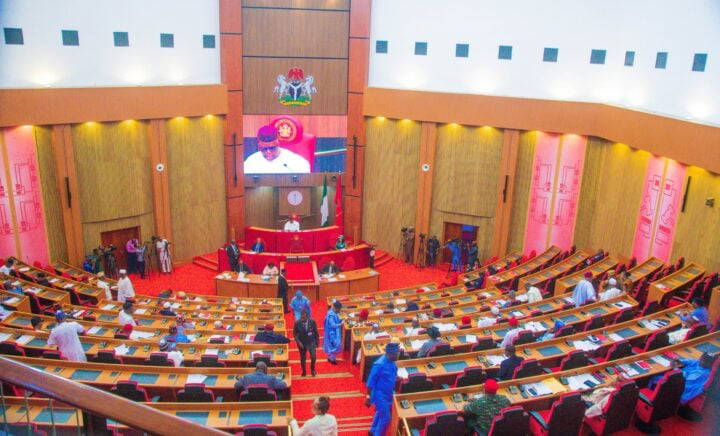
The Senate on Thursday demanded a detailed explanation from the Central Bank of Nigeria, CBN, regarding the alleged non-remittance of N1.44 trillion in operating surplus, even as the apex bank reported that the Nigerian economy had reached its most stable phase in over a decade.
The demand came during a statutory briefing of the Senate Committee on Banking, Insurance and Other Financial Institutions, chaired by Senator Tokunbo Abiru, who emphasised the need for transparency.
“The Auditor-General’s query on the unremitted funds requires a full, clear and documented response,” Abiru said, stressing that public trust in monetary governance depended on strict accountability.
While acknowledging CBN’s achievements in stabilising the foreign exchange market and reducing inflation, the senator insisted that such progress must be accompanied by institutional responsibility.
“The Senate expects the CBN to explain the circumstances surrounding the query, outline corrective steps taken and reveal safeguards against future lapses,” he added.
CBN Governor Olayemi Cardoso, who appeared before the committee, provided an extensive review of Nigeria’s economic conditions, asserting that the country is experiencing renewed macroeconomic stability. Cardoso attributed the improvements to bold monetary reforms, foreign-exchange liberalisation, and disciplined liquidity management introduced since mid-2025.
He reported that headline inflation had declined for seven consecutive months, from 34.6 per cent in November 2024 to 16.05 per cent in October 2025, marking the steepest disinflation trend in over ten years. Food inflation also slowed to 13.12 per cent, supported by better supply conditions and exchange-rate predictability.
Cardoso highlighted that the foreign-exchange market had been fundamentally transformed, with the premium between official and parallel markets falling to below two per cent compared with over 60 per cent a year earlier. As of November 26, the naira traded at N1,442.92 per dollar. External reserves rose to $46.7 billion, the highest in nearly seven years, while diaspora remittances tripled to about $600 million monthly.
He also noted that the $7 billion verified FX backlog had been fully cleared, and banking-sector recapitalisation was progressing smoothly, with 27 banks raising new capital and 16 meeting or surpassing regulatory thresholds ahead of the March 31, 2026 deadline.
Despite these positive indicators, the Senate questioned several policy decisions, including the 45 per cent Cash Reserve Ratio, FX forward settlements, mutilated naira notes, excessive bank charges, failed electronic transactions, and CBN subsidiaries’ compliance with parliamentary oversight. Abiru also requested updates on the Financial Services Regulatory Coordinating Committee to ensure stronger inter-agency cooperation.



Comments