
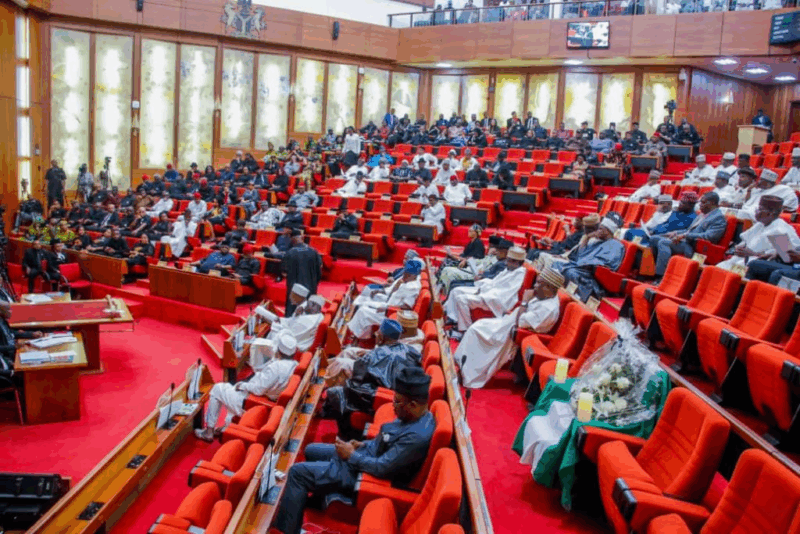
The Senate on Monday directed the National Drug Law Enforcement Agency, NDLEA, to resubmit an amended version of the bill that President Bola Tinubu declined to sign in June 2025.
The President withheld assent on the grounds that the proposed legislation conflicted with Section 58(4) of the 1999 Constitution.
In calling for the bill’s return, the Senate also encouraged the NDLEA to collaborate closely with the National Human Rights Commission, NHRC, to ensure a thorough overhaul of Nigeria’s drug-control framework.
The appeal was made by Senate Leader Opeyemi Bamidele during a technical workshop jointly hosted by the NHRC, civil society groups, and human rights advocates in Abuja. Bamidele was represented by his Chief of Staff, Charles Luri-Bala.
The workshop, titled “Towards a Comprehensive Drug Harm Reduction Strategy in Nigeria: Legislative Perspectives and Opportunities,” focused on strengthening drug legislation and reforming the country’s approach to drug-related issues. Bamidele praised the NHRC and its partners for convening a forum dedicated to shaping a more effective harm-reduction strategy.
He highlighted the Senate’s awareness of the deepening challenges posed by illicit drug use, noting the need for policies that balance public safety with the protection of human rights, especially for vulnerable groups. He stressed that the National Assembly favours a shift away from overly punitive practices toward approaches centred on treatment, rehabilitation, and reintegration.
According to him, “These are the issues that informed the decision of the 10th National Assembly to amend the National Drug Law Enforcement Act, 2004. But Mr. President declined assent to the bill because it conflicted with Section 58(4) of the Constitution of the Federal Republic of Nigeria, 1999 (as amended).”
Bamidele clarified that the President’s refusal does not foreclose the possibility of reintroducing the bill, provided the constitutional conflict is resolved. He encouraged stakeholders to work collectively to refine the legislation, saying its passage would transform Nigeria’s anti-drug efforts and contribute significantly to national development.
The Senate reaffirmed its commitment to supporting amendments that would provide strong legal and institutional backing for evidence-driven harm-reduction policies, adding that insights from the workshop would guide policy reforms.
The rejected amendment had proposed allowing the NDLEA to retain part of the proceeds seized from drug-related offenders. However, President Tinubu insisted that all such proceeds must be paid into the Federal Government’s Confiscated and Forfeited Properties Account.



Comments