
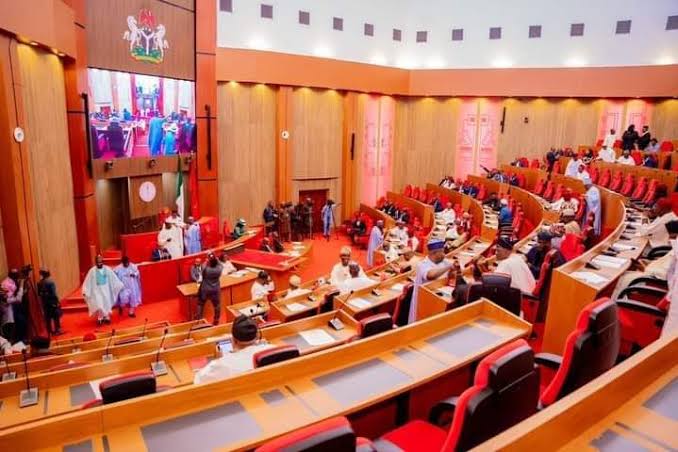
The senate on Thursday, October 16, has suspended further consideration of the electoral act (Repeal and amendment) bill, 2025, following an extensive debate on its general principles, to allow for wider consultation and a more thorough review of its provisions.
The bill seeks to repeal the electoral act 2022 and replace it with a new legal framework aimed at strengthening Nigeria’s electoral system, enhancing transparency, and promoting greater inclusiveness in the conduct of elections.
Key innovations proposed in the draft law include the introduction of digital result registers, QR-coded voter identification cards, and stricter deadlines for party primaries and the transmission of election results.
Presenting the bill, senator Simon Lalong, chairman of the senate committee on the Independent National Electoral Commission (INEC), noted that the 2023 general elections had significantly tested Nigeria’s democratic institutions.
According to him, while the electoral act 2022 brought about important reforms, it also revealed critical gaps such as delayed funding for elections, disputes over voter registration data, ambiguities in result transmission procedures, and inadequate enforcement of electoral offences.
“The key objectives of this legislation are to ensure transparency, efficiency, and integrity in our electoral system, guarantee free and fair competition among political parties, and restore public confidence in elections,” Lalong said.
“Nigerians expect us to respond not with patchwork corrections, but with a holistic law that strengthens INEC’s independence and rebuilds trust in the process.”
Lalong said the proposed legislation would strengthen INEC’s independence by insulating it from political interference and government control.
He added that the bill mandates early release of election funds, continuous voter registration (CVR), and the use of technology to enhance transparency in result management.
However, Emmanuel Udende, senator representing Benue north-east, raised concerns that copies of the bill had not been made available to lawmakers for detailed review.
Responding, Jibrin Barau, deputy senate president who presided over the plenary, said the second reading of any bill is meant to address its general principles, while specific clauses would be considered at the committee stage.
Several lawmakers, including Titus Zam from Benue north-west and Binos Yaroe from Adamawa, supported the bill, describing it as timely and critical to electoral reform.
“This is a very ambitious exercise that is aimed at strengthening our electoral system. And so, I support the second reading of the bill as proposed by my dear brother, senator Simon Lalong. I so submit,” Zam said.
Senate president Godswill Akpabio, who shared his experience from the 2019 elections, stated that the wrong officials were punished for electoral misconduct.
Akpabio stressed that any amendment to the electoral act must ensure that INEC is held accountable for infractions committed during elections.
He also called for a review of the campaign timetable, noting that prolonged campaign periods undermine governance.
“In a four-year term, government effectiveness suffers when ministers and public officers spend almost a year campaigning,” Akpabio said.
The senate president agreed that members needed more clarity on the proposed amendments and suggested a closed session for further briefing.
Akpabio added that although the bill aims to modernize Nigeria’s electoral framework, lawmakers must reach a shared understanding before proceeding to the committee stage.
He then called for a voice vote on a motion to step down the bill pending further consultations.
Opeyemi Bamidele, the senate leader, moved a formal motion to defer further consideration on the bill to another legislative day.
Abba Moro, minority leader, seconded the motion, and it was unanimously adopted by the chamber.
Bamidele said the suspension would allow senators to conduct wider stakeholders’ engagement and ensure the bill reflects the aspirations of Nigerians.



Comments