
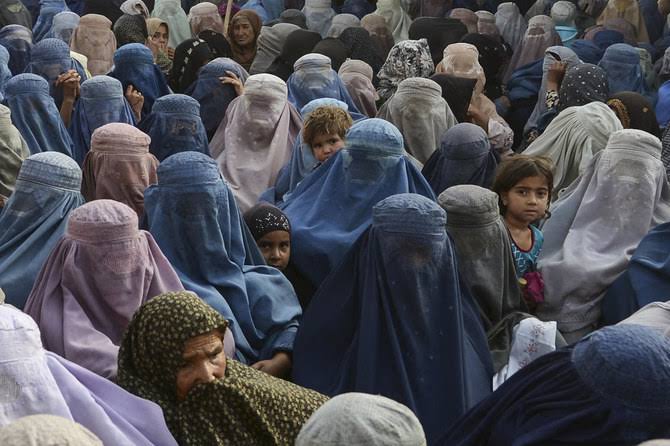
Afghan women will be required to wear the Islamic face veil for the first time in decades under a rule issued by the country’s ruling Taliban terrorists.
A male guardian might be jailed for three days if a woman refuses to cooperate and defies official warnings to male members of her household.
During their first term in office in the 1990s, the Taliban imposed the all-encompassing burka.
Since taking control last year, they had not enforced it in Afghan cities.
Many Afghan women already wear the burka, but others, particularly in urban areas, opt for a basic hair covering.
According to BBC, The Taliban’s Ministry for the Prevention of Vice and Promotion of Virtue issued the order.
Muslims, including men and women, are commanded by the Quran to dress modestly. Male modesty is defined as covering the space between the navel and the knee. When in the presence of men who are not related or married to them, it is customary for women to cover everything except their face, hands, and feet.
However, within Islam, there has been substantial discussion about whether this goes far enough. As a result, the hijab (Arabic for “covering up”) and the niqab have been separated (meaning “full veil”).
The hijab is a scarf that covers the hair and neck, whereas the niqab is a facial veil that leaves the region around the eyes unveiled. It’s usually paired with a matching headscarf or abaya, a full-length robe, and a separate transparent eye veil.
The burka completely conceals the face and body, leaving just a mesh screen for visibility.
Many of the Taliban’s severe prohibitions for daily living are directed at women.
Afghanistan has become the world’s only government to officially prohibit education based on gender, a key stumbling block in the Taliban’s bid for international legitimacy.
Secondary education for girls has been prohibited, the ministry of women’s affairs has been dismantled, and in many situations, women have been denied the right to work.





Comments