
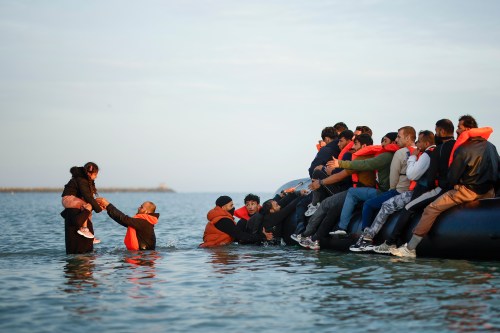
The United Kingdom (UK) has sanctioned 25 targets involved in alleged human trafficking, under a new financial sanctions regime targeting those facilitating the travel of refugees and migrants across the English Channel via small boats.
On Wednesday, July 23, the UK targeted a range of individuals and organizations, including a small boat supplier in Asia and gang leaders operating in the Balkans and North Africa. Also sanctioned were ‘middlemen in the middle East who channel funds through the Hawala money transfer system’, which is commonly used to finance Channel crossings.
However, the effectiveness of the sanctions remains uncertain, as UK authorities can only freeze assets located within the country, while most of those involved in the trafficking networks are based abroad.
Foreign Secretary David Lammy said that, “this is a significant step in the government’s efforts to combat organized immigration crime and curb irregular migration to the UK.”
He said, “We are confronting people smugglers across continents from Europe to Asia holding them accountable wherever they operate and making sure they face consequences for facilitating illegal migration.”
This action comes after the introduction of the Border Security, Asylum and Immigration Bill, which aims to strengthen enforcement powers for police and partner agencies to investigate and prosecute people smugglers more effectively.
Under the newly launched sanctions regime rolled out two days ago, the government now has the authority to freeze assets, impose travel bans, and cut off access to the UK’s financial system for individuals and entities linked to irregular migration, without needing to rely on criminal or counter terrorism legislation.
Those sanctioned include Bledar Lala, an Albanian national who leads the Belgian arm of a smuggling network, as well as a Chinese company that marketed small boats for smuggling through an online platform.
The rising number of refugees and migrants arriving on England’s southern shores in small boats from northern France remains a key political challenge for Prime Minister Keir Starmer’s Labour government. The issue has been amplified by the growing support for Reform UK, an opposition party building support through its strict anti-immigration stance.
Starmer, who is expected to speak on the issue, recently finalized migration agreements with both France and Germany.
The prime minister and French President Emmanuel Macron reached a ‘one in, one out’ arrangement, under which refugees and migrants arriving in the UK via small boats would be returned to France. In return, the UK would accept an equal number of migrants from France through a newly established legal pathway, subject to full documentation and rigorous security screening.
Recently, the UK and Germany signed a landmark defence agreement, with Berlin pledging to criminalize the facilitation of migrant and refugee smuggling into the UK. The proposed legal reform, set to pass by the end of the year, would grant German authorities enhanced powers to investigate and take action against storage sites and facilities used to hide small boats intended for Channel crossings.
It is recorded that about 37,000 people crossed the English Channel in 2024, and over 22,000 have made the journey so far in 2025, marking a nearly 50 percent rise compared to the same period last year. Dozens have died trying to make the crossing.




Comments