
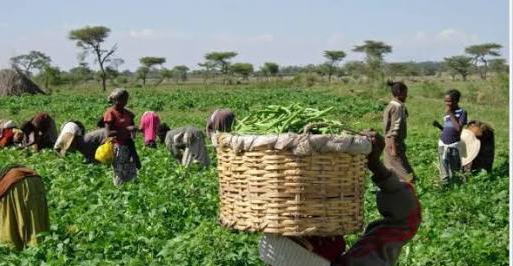
The federal government has launched a new set of agricultural reforms aimed at ending hunger, and reducing post harvest losses, which are estimated at over $10 billion annually.
The announcement was made in a joint statement by the minister of agriculture and food security, Abubakar Kyari, and the minister of State, Aliyu Abdullahi, on Thursday November 6.
These initiatives align with President Bola Tinubu’s Renewed Hope Agenda for food security and national prosperity.
Kyari emphasized the critical role of agriculture in Nigeria’s economy.
“Agriculture remains the largest employer in Nigeria and contributes over one quarter of our Gross Domestic Product. Beyond these figures, it reflects our nation’s resilience and is the foundation for national renewal, he said.
He added that the government’s reforms are designed to end hunger, ensure food sufficiency, and drastically reduce post-harvest losses that drain the agricultural value chain.
The reforms include enhancing mechanization, expanding irrigation, and improving storage systems to create a connected post-harvest system, ultimately boosting food quality, farmer incomes, and price stability nationwide.
President Tinubu has called for a shift from traditional farming methods to mechanized agriculture, stating, “Our farmers must transition from hoes and cutlasses to tractors and harvesters.
“Food sufficiency is the first currency of national stability.”
Key programs supporting this transition include the national agricultural growth scheme agro pocket, the renewed hope agricultural mechanisation programme, and the Nigeria Postharvest Systems Transformation Program (NiPHaST).
NiPHaST aims to strengthen post-harvest handling and storage from community level upwards, connecting farmers, cooperatives, and strategic reserves.
A recent milestone was the introduction of rainfed wheat cultivation in Kuru, Plateau state, allowing wheat production beyond irrigated zones.
With this development, all year wheat farming is now possible in Plateau, Taraba, and Cross River states.
The government is also enhancing operations at the national strategic grain reserve silos across several states to support emergency interventions and price stabilization.
To finance these reforms, president Tinubu approved the recapitalization of the Bank of Agriculture (BoA) with N1.5 trillion, alongside a N250 billion financing window for smallholder farmers.
The bank, in partnership with Heifer Nigeria, launched the renewed hope national agricultural mechanisation program to expand access to tractors and mechanized services nationwide.
Additional initiatives include rural infrastructure development such as feeder roads, mini dams, solar powered boreholes, and market access facilities to strengthen rural livelihoods.
Abdullahi emphasized that food self sufficiency would rely on climate-smart and inclusive agricultural reforms, optimizing production of crops like maize, wheat, sorghum, millet, soybean, cassava, yams, and cowpeas.
He also highlighted the development of climate-resilient crops and integrated soil-crop and pest management systems.
Other key initiatives include the Dry Season Initiative, Every Home a Garden Initiative led by the First Lady, and the Nigerian Farmers’ Soil Health Scheme, which provides crop and location specific fertilizer recommendations.
The broader goal is to reduce import dependence, strengthen market confidence, and revive agribusiness, positioning Nigeria as a leading food supplier in West Africa.
Agriculture has long been the backbone of Nigeria’s economy, sustaining millions of rural livelihoods.
However, low mechanization, poor infrastructure, and post-harvest losses have limited its potential.
These reforms aim to modernize the sector and ensure food abundance for all Nigerians.




Comments