
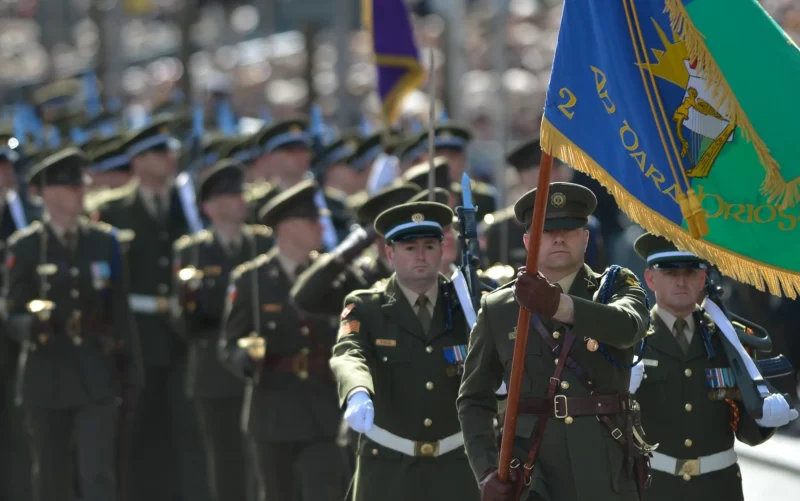
Ireland on Tuesday, February 10, announced that it is considering fast-tracking citizenship for foreign nationals who serve in its military.
The proposal is one of several measures outlined in a framework published by the defence forces on Tuesday aimed at boosting recruitment and promoting greater diversity within the service.
A spokesman for the defence forces said: “This action in the detailed implementation plan is to evaluate the possible adoption of measures to enable easier access to citizenship for those who serve in the defence forces. The evaluation is due to complete at the end of June 2026.”
The move reflects Ireland’s pivot in recent years from a country of emigration to one that has attracted record numbers of migrants.
Immigrants currently must have lived in the Republic for five of the previous nine years before being allowed to apply for naturalisation, and must pay around €1,000 (£870) in fees.
But people who have served in the forces for a number of years could be allowed to become naturalised citizens and have their application fees waived.
The policy was previously mooted in the 2022 commission on the defence forces report, which said those who serve should be provided easier access to Irish citizenship as recognition of their commitment to this state.
The Irish government wants to increase personnel numbers from 7,500 to 11,500 by 2028 as it grapples with growing international threats.
Despite a boost in numbers last year, officers say it is an unrealistic goal, with the representative association of commissioned officers having previously described the target as a major challenge.
Currently, refugees and nationals from states in the European economic area can enlist in the Irish army, as well as non-nationals who have a minimum of three years’ legal and unbroken residency and meet government criteria.
The proposal would follow other militaries such as the United States (U.S), which allows servicemen to apply for citizenship after one year, and France, which allows foreign volunteers who serve in the French Foreign Legion and complete three years of service or become injured, to become eligible for nationality.
Ireland has approximately 250 foreign-born members of the defence forces, who hail mostly from the United Kingdom (UK) and Poland.
While historically a country of mass emigration, Ireland has in recent years become a destination for a large number of migrants from the EU and beyond, which has sparked tensions in certain pockets of the country.
Last year, around 1,000 anti-immigration protesters clashed with police outside an asylum seeker hotel in south-west Dublin after reports emerged of a child having been sexually assaulted on its grounds.
Net migration in Ireland has nearly doubled since 2022 to an average of 72,000 a year.
The number of immigrants arriving from outside the European Union jumped from almost 17,000 in 2007 to more than 50,000 in 2023, while annual applications for asylum rose to nearly 13,800 in 2022, a more than nine-fold increase over 2014.
The rate of the population increase prompted the government of Ireland to unveil tighter immigration and asylum measures last November.
The Irish government has come under fire from opposition parties such as Sinn Féin, which have condemned its failure to tackle recruitment rates as posing a serious risk to the future of our defence forces.
The force has also introduced a record €1.35bn (£1.17bn) budget and increased starting salaries to more than €40,000 (£34,800) for a three-star private after training in a bid to attract recruits.




Comments