
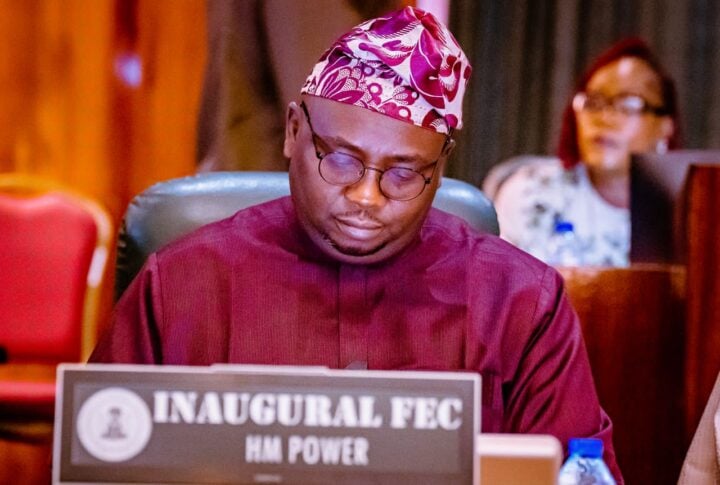
The minister of power, Adebayo Adelabu, has issued a formal apology to Nigerians following weeks of widespread electricity outages that have disrupted daily life and economic activity across the country.
He projected that power supply would begin to stabilise within two weeks.
Speaking in Abuja, Adelabu acknowledged the strain the persistent blackouts have placed on households, businesses, schools, and industries, particularly amid rising temperatures that have driven up demand for electricity.
In an unusually candid admission, he said, “I want to apologise to Nigerians, officially now, coming from me as the minister of power, for this temporary issue that is leading to hardship being experienced, especially during this dry season, where there is so much heat everywhere.
“Businesses are being affected, schools have been affected, and industries have been affected. It is not our wish to find ourselves in this situation, but it is due to some factors that are actually beyond our control.”
The minister, however, reassured Nigerians that improvements are on the horizon, projecting that power supply would begin to stabilise within two weeks.
He linked this optimism to ongoing repair work on critical gas infrastructure and renewed commitments from suppliers.
“I can tell you, with the committee that we have set up, and commitments from gas suppliers, and the timeline for repair of the gas pipelines, two weeks from now, we should start seeing improvements in supply. Two weeks,” Adelabu said.
He disclosed that the government has clear timelines for the restoration of key facilities, including those operated by Seplat Energy, which are expected to boost gas availability to power plants once repairs are completed.
To address long-standing supply challenges, Adelabu revealed that a dedicated monitoring team has been established to ensure gas producers meet their domestic supply obligations — a critical factor in sustaining electricity generation.
“We already have a committee that is working on this to track compliance with the domestic supply obligations of these gas companies to our power plants,” he said, adding that improved payment systems would also encourage greater participation from suppliers.
Nigeria’s electricity sector, heavily reliant on gas-fired generation, has recently faced setbacks due to disruptions in gas supply, pipeline maintenance issues, and financial constraints within the system.
While acknowledging these structural problems, the minister said efforts are ongoing to restore stability.
“We are working on it 24/7 to make sure that we go back to the trajectory of 2025, when Nigerians commended us for a good job well done,” he said.
Looking ahead, Adelabu reaffirmed the government’s target of increasing electricity generation to 6,000 megawatts by the end of 2026, describing the current situation as a temporary setback within a broader reform agenda.
“Power generation will improve, transmission will improve, distribution will improve, and that 6,000 megawatts will be achieved before the end of this year, and Nigerians will be better for it,” he assured.
He further stressed the administration’s intention to exceed previous performance benchmarks.
“If we could provide such service in 2025, this is 2026, we are willing to do more, to even do better,” Adelabu said.


Comments