
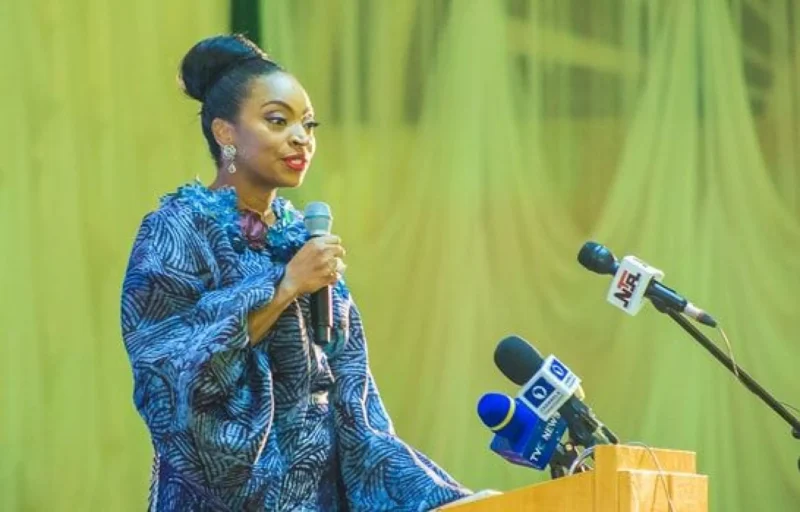
The Minister of Industry, Trade and Investment, Jumoke Oduwole, has raised concerns over the ministry’s proposed ₦2.72 billion capital allocation for 2026, warning that the amount is insufficient to support Nigeria’s industrialization, trade expansion, and investment attraction agenda.
Speaking before the joint Senate Committees on Trade and Investment and Industry, she appealed for a targeted increase in funding to enable the ministry to fully deliver on its mandate and support President Bola Tinubu’s Renewed Hope Agenda and the country’s drive toward a trillion-dollar economy.
Oduwole emphasized the ministry’s central role in diversifying Nigeria’s economy, promoting non-oil exports, stimulating domestic production, and attracting both local and foreign investment.
She highlighted that the ministry had achieved significant milestones in recent years, including attracting $21 billion in capital importation in the first ten months of 2025, up from $12 billion in 2024 and under $4 billion in 2023.
These gains were attributed to interventions such as the development of over $5 billion in bankable projects, sector-specific deal rooms, Nigeria’s first Domestic Investor Summit, resolution of more than 50 major investor bottlenecks, and over 100 bilateral investment engagements with countries including the United Kingdom, United States, United Arab Emirates, Brazil, and Japan.
Notably, UK investors accounted for 65 percent of Nigeria’s foreign capital inflows in 2025.
On trade, the minister reported that Nigeria recorded a trade surplus in 2025, with total trade valued at ₦113 trillion in the first three quarters and exports rising 11 percent year-on-year to $6.1 billion, the highest in the country’s history.
She attributed this growth to export facilitation measures, expansion of warehouses, new air cargo corridors to Africa, and improved implementation of the African Continental Free Trade Area, AfCFTA.
Industrial initiatives through special economic zones generated over $500 million in export revenue and created more than 20,000 direct jobs.
The Federal Executive Council, FEC, also approved the National Industrial Policy, and Nigeria secured the rights to host CANEX 2026 and the Intra-Africa Trade Fair 2027.
Despite these achievements, Oduwole warned that inadequate capital funding was constraining the ministry’s effectiveness. She noted that while personnel and overhead allocations were fully utilized in 2024 and 2025, capital releases were inconsistent, with no funds released in 2025 at the time of her presentation.
The minister stressed that her ministry is programme-led, facilitating investment, removing regulatory bottlenecks, and promoting Nigerian products, and that achieving its 2026 agenda — including boosting non-oil exports, deepening AfCFTA implementation, and rolling out digital trade platforms — would be difficult without enhanced capital resources.
Senators acknowledged the ministry’s importance to the country’s economic vision but emphasized that support would depend on transparency, accountability, and measurable impact.
The committees said Oduwole’s concerns would be carefully considered during continued scrutiny of the 2026 budget.



Comments