
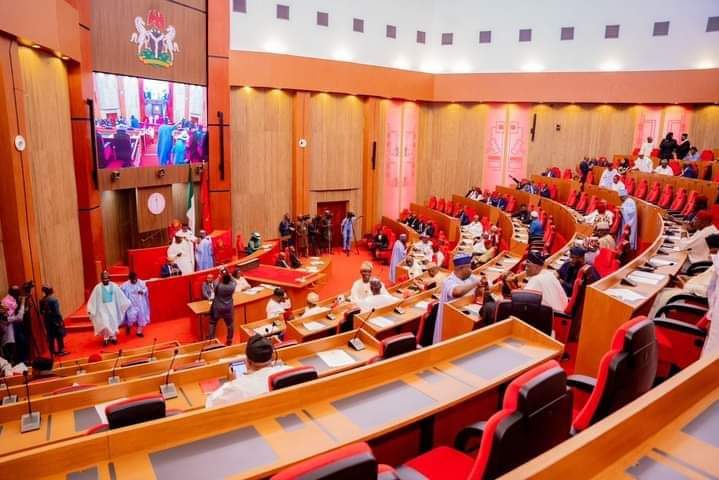
The Senate on Tuesday passed the Electoral Act, 2022 (Repeal and Re-Enactment) Bill 2026 after a tense plenary marked by sharp disagreements among lawmakers.
Drama unfolded shortly after proceedings resumed when Senator Enyinnaya Abaribe of the African Democratic Congress, ADC, representing Abia South, demanded a division on Clause 60.
The move triggered heated exchanges across party lines.
Senate President Godswill Akpabio initially said he was under the impression that the request had earlier been withdrawn, but opposition lawmakers quickly challenged that position.
Invoking Order 52(6), Deputy Senate President Barau Jibrin maintained that it would be procedurally improper to reopen any section already ruled upon by the presiding officer.
His position further inflamed tensions in the chamber, leading to a brief confrontation between Senator Sunday Karimi and Abaribe.
Seeking to calm the situation, Senate Leader Opeyemi Bamidele reminded colleagues that he had moved the motion for rescission, stressing that prior decisions of the Senate had effectively been set aside.
He argued that Abaribe’s call for division aligned with that motion.
Akpabio, however, suggested the demand for a vote was aimed at publicly registering Abaribe’s position before Nigerians. He upheld the point of order, prompting Abaribe to rise in objection before being asked to formally present his motion.
Rising under Order 72(1), Abaribe called for a division on Clause 60(3), specifically concerning the provision that if electronic transmission of results fails, Form EC8A should not serve as the sole basis, calling for the removal of the proviso that allows for manual transmission of results in the event of network failure.
A vote was subsequently conducted. Senators in favour of retaining the caveat were asked to stand, followed by those against it.
Fifteen opposition lawmakers stood in rejection of the proviso, while 55 senators supported retaining it, according to the tally announced by the Senate President.
Earlier, legislative activities had briefly stalled during clause-by-clause scrutiny of the bill after a motion was introduced to rescind an earlier amendment.
The rescission motion was seconded, allowing the chamber to dissolve into the Committee of the Whole for detailed reconsideration of the proposed law.
As Akpabio read through the provisions for debate, proceedings hit another snag at Clause 60 when Abaribe raised a point of order, drawing widespread attention and consultations among senators.
Lawmakers clustered in small groups and approached the presiding officer’s desk amid rising murmurs.
The tension eventually led to a closed-door session before plenary resumed and the bill was passed.




Comments