
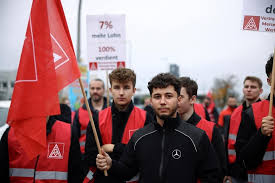
Thousands of German workers embarked on a nationwide strike in the early hours of Tuesday, October 29 demanding higher wages thus adding to the concerns of companies striving to remain competitive amidst rising costs, weak exports and increasing foreign competition.
Unionized workers from the nearly four million strong electrical engineering and metal sectors affected major companies like Porsche AG, BMW and Mercedes.
A deteriorating business climate in Europe’s largest economy have increased pressure on the fragile coalition government of Germany’s Chancellor, Olaf Scholz, which may be close to falling apart ahead of next year’s federal elections as policy disagreements grow.
Scholz is scheduled to meet with business leaders, including Volkswagen CEO Oliver Blume, on Tuesday, October 29, but his administration has tempered expectations for immediate outcomes.
Additionally, in a sign of governmental disarray, his finance minister has called for a separate summit on the same day.
Germany has a long tradition of ‘warning strikes’ during wage negotiations, but these actions come as employers face increasing anxiety about the future.
A prominent business association reported that a survey of companies indicates Germany is likely to experience another year of economic decline in 2024, with no signs of growth on the horizon.
Martin Wansleben, managing director of the German Chamber of Commerce and Industry (DIHK) said, “We are not just dealing with a cyclical, but a stubborn structural crisis in Germany.
“We are greatly concerned about how much Germany is becoming an economic burden for Europe and can no longer fulfil its role as an economic workhorse.”
A different survey conducted by the German Association of the Automotive Industry (VDA) auto industry association indicated that the transformation of the German automotive sector could result in 186,000 job losses by 2035, with approximately a quarter of those having already taken place.
“It is becoming increasingly clear that there is no room for interpretation: Europe especially Germany is losing more and more international competitiveness.
“The price of electricity for German companies is up to three times higher than for international competitors, e.g. from the USA or China.
“Germany is a country with the highest taxes and the bureaucratic burdens are constantly increasing,” the VDA report said.
The strikes were organized by the influential Industrial Union of Metalworkers (IG Metall), which also led a walkout during the night shift at Volkswagen’s factory in Osnabrueck, Germany.
Workers there are concerned about the potential closure of the site.
IG Metall is calling for a 7% pay increase, while employers have proposed a 3.6% raise over 27 months.
Companies argue that these demands are unrealistic.
“Wage restraint does not create jobs.
“Our difficult situation has completely different causes than high wages,” Harald Buck, works council chairman of Porsche AG at the Zuffenhausen plant in Stuttgart, Germany, said.
Approximately 500 workers left their posts during the night shift, followed by around 4,000 who joined a demonstration during the early shift.
In a separate development, the next round of discussions between Volkswagen and labor representatives is scheduled for Wednesday, October 30.
However, the head of the company’s works council has warned that he may end the talks.






Comments