
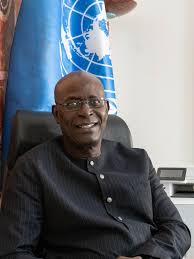
Mohammed Fall, the Humanitarian Coordinator in Nigeria, announced on Monday September 17 that $6 million will be allocated from the Nigeria Humanitarian Fund (NHF) to aid flood victims in Borno State.
The Alau Dam situated about 10 miles south of Maiduguri, the capital of Borno state, collapsed on Tuesday, September 10, forcing hundreds of thousands to evacuate their homes.
At a press conference in New York on Monday, September 16, UN spokesperson Stephane Dujarric stated that over the weekend a joint mission consisting of UN agencies, NGOs and the Nigeria Red Cross Society visited the main city of Maiduguri.
Dujarric mentioned that they met with individuals affected by the flood, many of whom had already been displaced several times due to conflict and insecurity in the region.
He said, “we and our partners are providing them with hot meals, we are facilitating air drops of food in hard-to-reach areas cut off by flood waters and we are also trucking in water.
“We are also providing water and sanitation hygiene services and water purification tablets to stem disease outbreaks.
“This is in addition to supplying hygiene and dignity kits to women and girls as well as emergency health and shelter services.”
Dujarric stated that the staff at the UN Office for the Coordination of Humanitarian Affairs are collaborating closely with donors to obtain additional funding.
In Nigeria, flooding has impacted over 125,000 hectares of farmland occurring right before the harvest season and at a time when 32 million people in the country are experiencing severe food insecurity.
Earlier, Emmanuel Bigenimana, the head of the World Food Programme (WFP) office in Maiduguri, said that he was able to conduct a quick damage and needs assessment by flying over the city in a UN Humanitarian Air Service helicopter provided by WFP.
He said, “What I have seen is really heartbreaking,” describing homes, infrastructure, roads, schools, hospitals submerged by water.
He added that, “many, many people I’m talking about over 200,000 – 300,000 displaced people are overcrowded in several IDP (Internally Displaced Persons) camps and also on the streets.”
WFP reported that the dam collapse caused river water to flood 50 percent of Maiduguri.
In response, state authorities issued evacuation orders for residents in the affected areas and called for humanitarian assistance.
From the center of one of the IDP camps in Borno, Bigenimana stated that WFP had set up soup kitchens to offer hot meals to those affected and was increasing its response efforts in coordination with authorities and partners.
“The soup kitchens located in three camps : Teachers’ Village, Asheikh and Yerwa, aim to provide nutritious hot meals to 50,000 of the worst affected children, women,and men who have lost their homes but more assistance is needed, WFP said.
Bigenimana stressed that, “this is really an additional burden to already existing crises.
“This region has been facing conflict for a decade.”
Borno State was among the regions most severely impacted by the Boko Haram insurgency, which the UN reported earlier this year has been partially brought under control.
“More recently, we have seen food inflation, food prices have been skyrocketing, really affecting millions of people who are facing food insecurity,” Bigenimana added.
The effects of extreme weather are being strongly felt throughout the country.
According to WFP, by September 2024, floods have affected around 800,000 people across 29 states in Nigeria and inundated over 550,000 hectares of farmland.
As of March, approximately 32 million people in Nigeria were already experiencing acute hunger.
The UN’s food agency has stated that it requires $147.9 million to assist food-insecure individuals in Nigeria’s northeast over the next six months.
For the flood-affected communities in Maiduguri, “recovery will be a prolonged process.”
“We need more resources to save lives and to put together efforts to respond to the crises, as well as think of long-term recovery and solutions,” Bigenimana concluded.





Comments